.png)

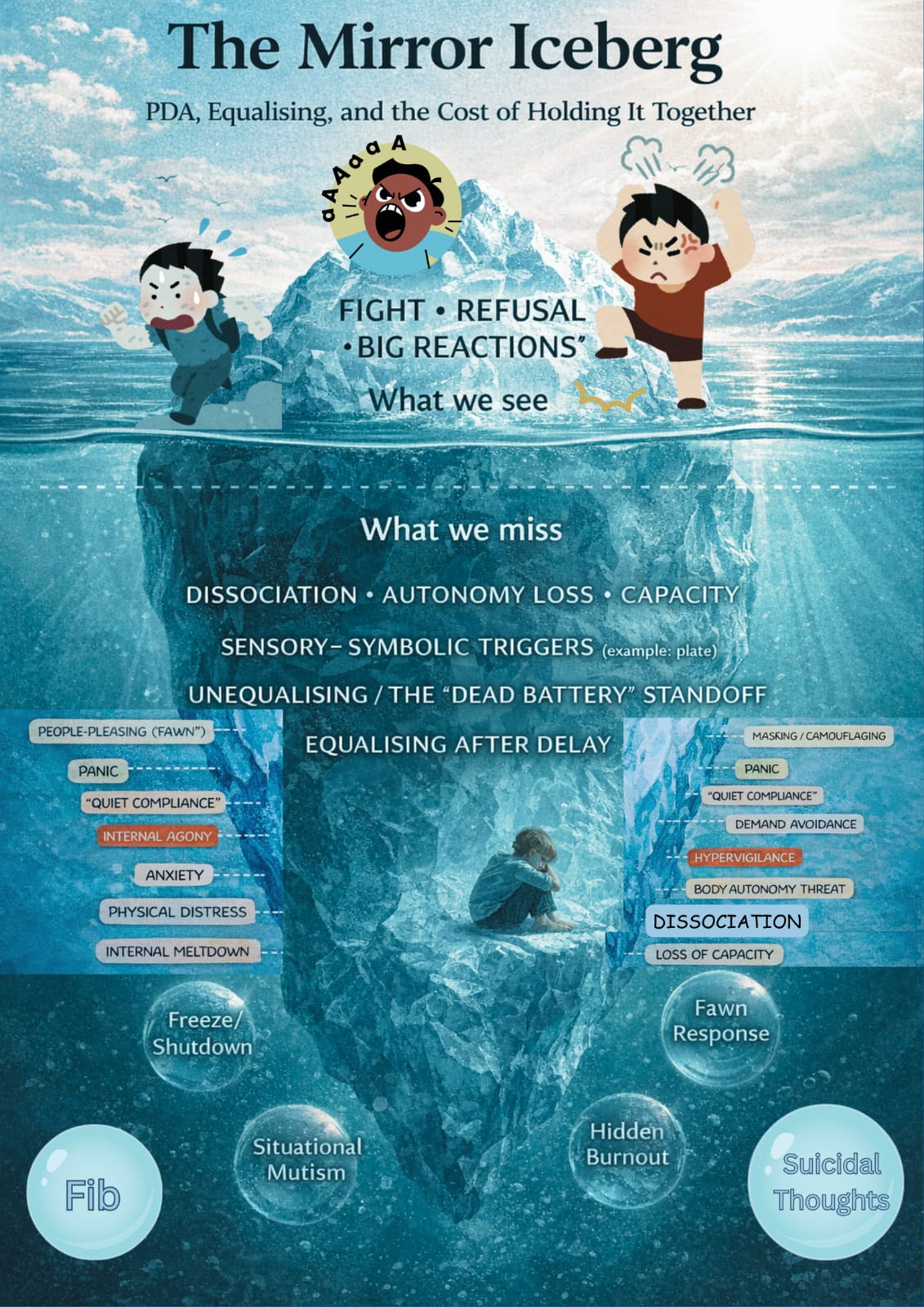
PDA is often described in terms of behaviour: meltdowns, refusals, or “big reactions.” But what we see on the surface is only a small part of the story.
PDA is also often described as a linear spectrum—from internalised to externalised. But this framing misses something essential.
For a long time, I described my experience as internalised PDA after watching Sally Cat’s video guide on internalised PDA. That language helped me name something real—the way my nervous system collapses inward under demand. But I now understand this isn’t a separate “type” of PDA.
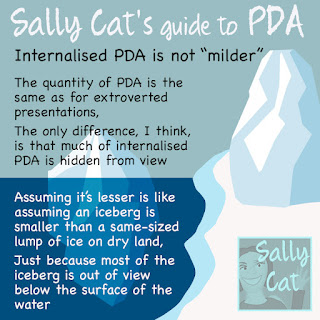
What looks like calm, compliance, or silence from the outside is actually my nervous system entering survival mode—most often through funster, fawn, or freeze. My voice doesn’t argue; it locks. Not because I agree, but because my capacity to resist safely has dropped too low.
Arthur and I aren’t different kinds of PDAers. We are responding to the same loss of autonomy—just through different survival pathways, shaped by capacity and context.
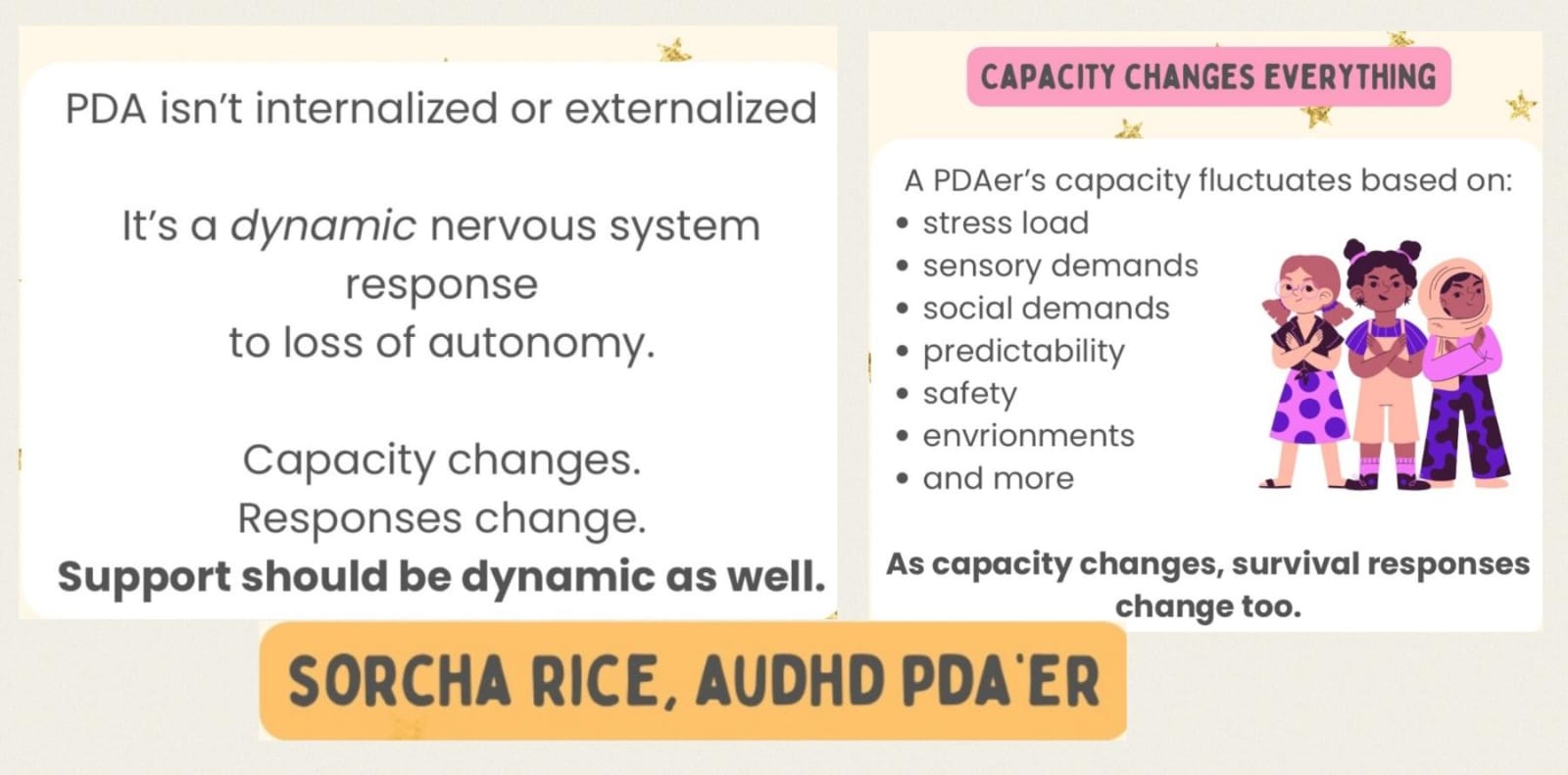
Instead of a straight line, PDA is better understood as a dynamic distribution of nervous system dimensions, including:
- Threshold of Tolerance: the tipping point where nervous system activation spills into visible action.
- Window of Tolerance: the fluctuating space where demands can be processed without triggering survival responses.
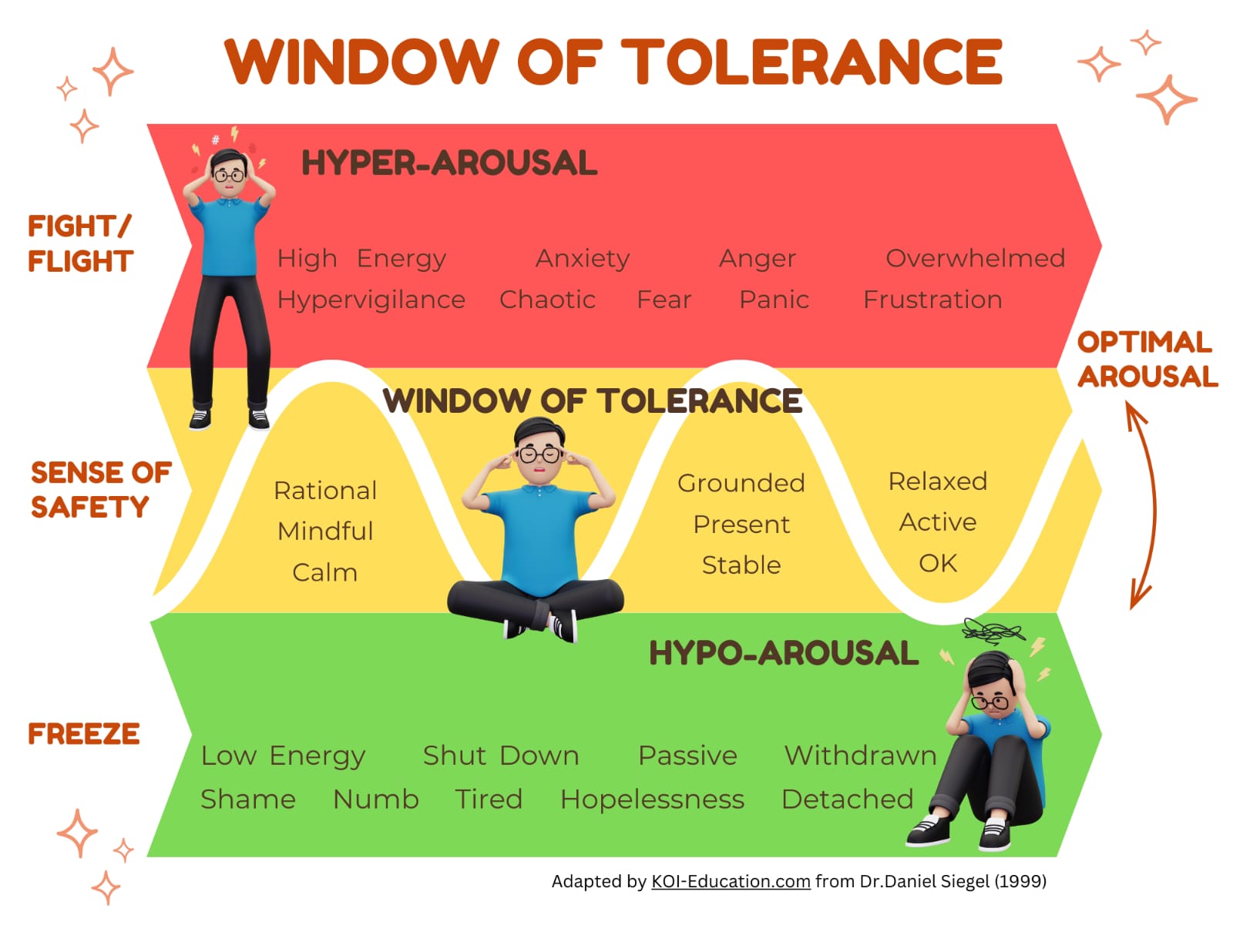
- Strength of the Autonomy Drive: the intensity with which autonomy is protected—sometimes overriding biological needs.
- Co-occurring Factors: sensory processing, executive functioning, communication access, and social differences that shape how PDA is expressed.
The Visible and the Hidden: Two Sides of the Same Nervous System Load
Like an iceberg, most of what shapes a PDAer’s responses lives below the waterline—in the nervous system, not in choice or intent. This is why two children (or a child and a parent) can experience the same loss of control and respond in completely different ways. One may “move the world.” The other may go quiet. Both are surviving.
Some PDAers externalise distress. Their “no” is loud, visible, and immediate. Others internalise. They may appear compliant, frozen, or agreeable—until they suddenly aren’t.
This difference is often misunderstood as personality, severity, or even “who is more PDA.” But it’s more accurate to think in terms of capacity. A nervous system can only hold so much before it has to restore balance.
Sometimes that restoration looks like:
- yelling, refusing, pushing away, or
- going silent, dissociating, or complying while the body absorbs the cost.
The Seeds of Autonomy: “No way. Goodbye.”
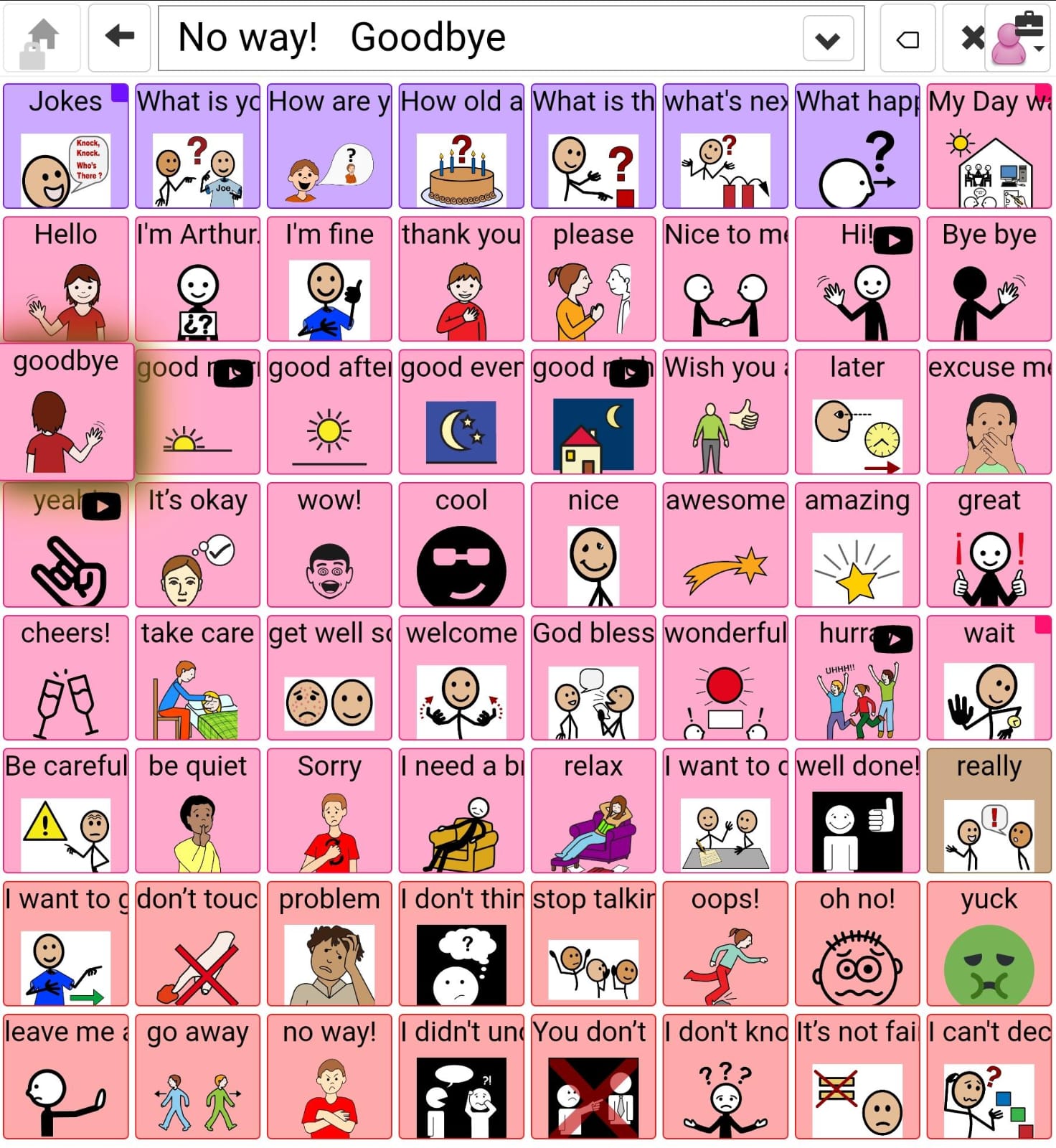
This nervous system logic—autonomy as survival—was already present in Arthur years ago.
Looking back at my notes from May 14th, 2020—Arthur’s fourth birthday—I found a moment that still feels foundational. At the time, I tracked Arthur’s AAC use closely—not to measure “progress,” but to understand how and when he chose to communicate. One pattern was unmistakable: Arthur communicated strictly on his own terms.
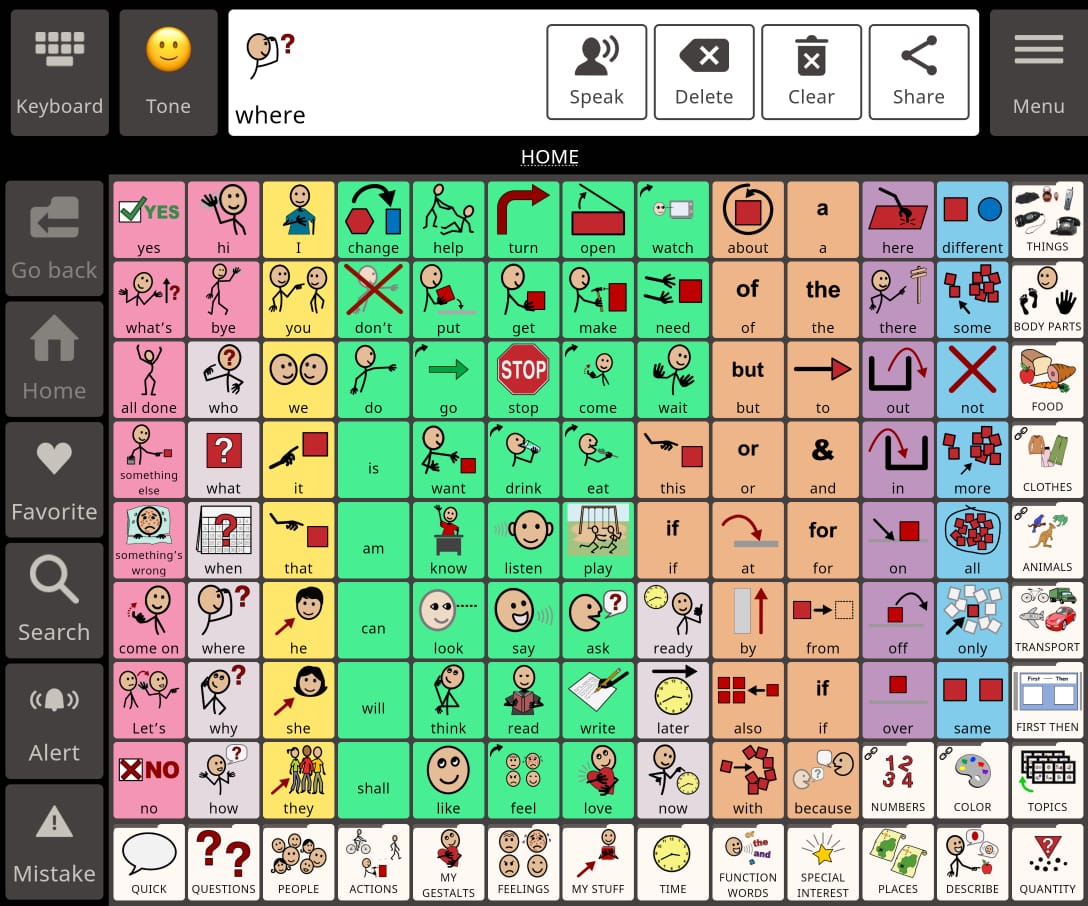
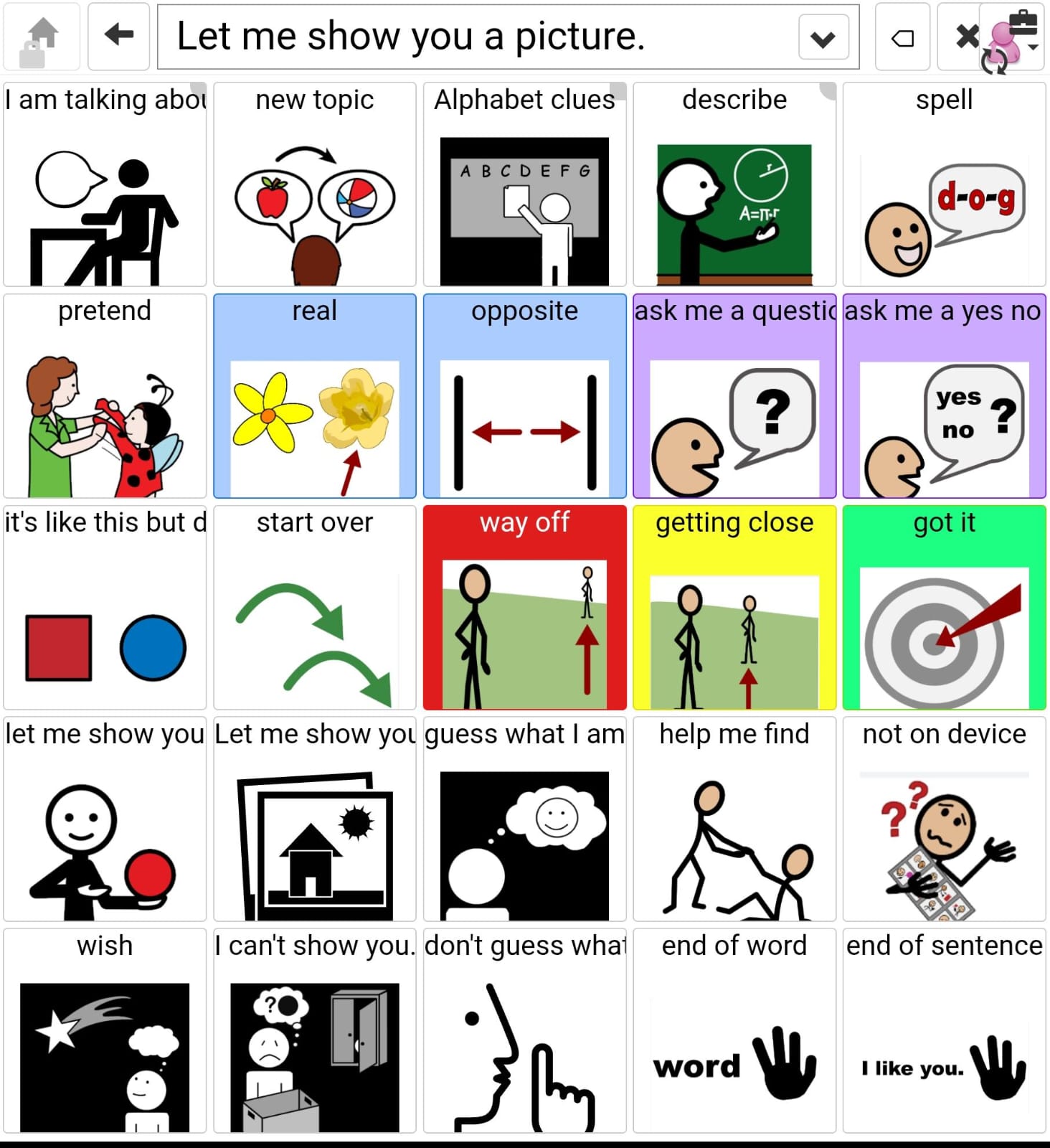
I had asked him to take a bath, already anticipating resistance. His CoughDrop AAC app was open to the social page. Without hesitation, he pressed two buttons:
No way!
Goodbye
I remember feeling joy—not just because we avoided a meltdown, but also because of the clarity and humour.
Now I understand that this wasn’t defiance. This was equalising—the restoration of agency. He wasn’t refusing a bath; he was asserting authorship over his body and time. At four years old, with words finally accessible, he already knew how to move the world.
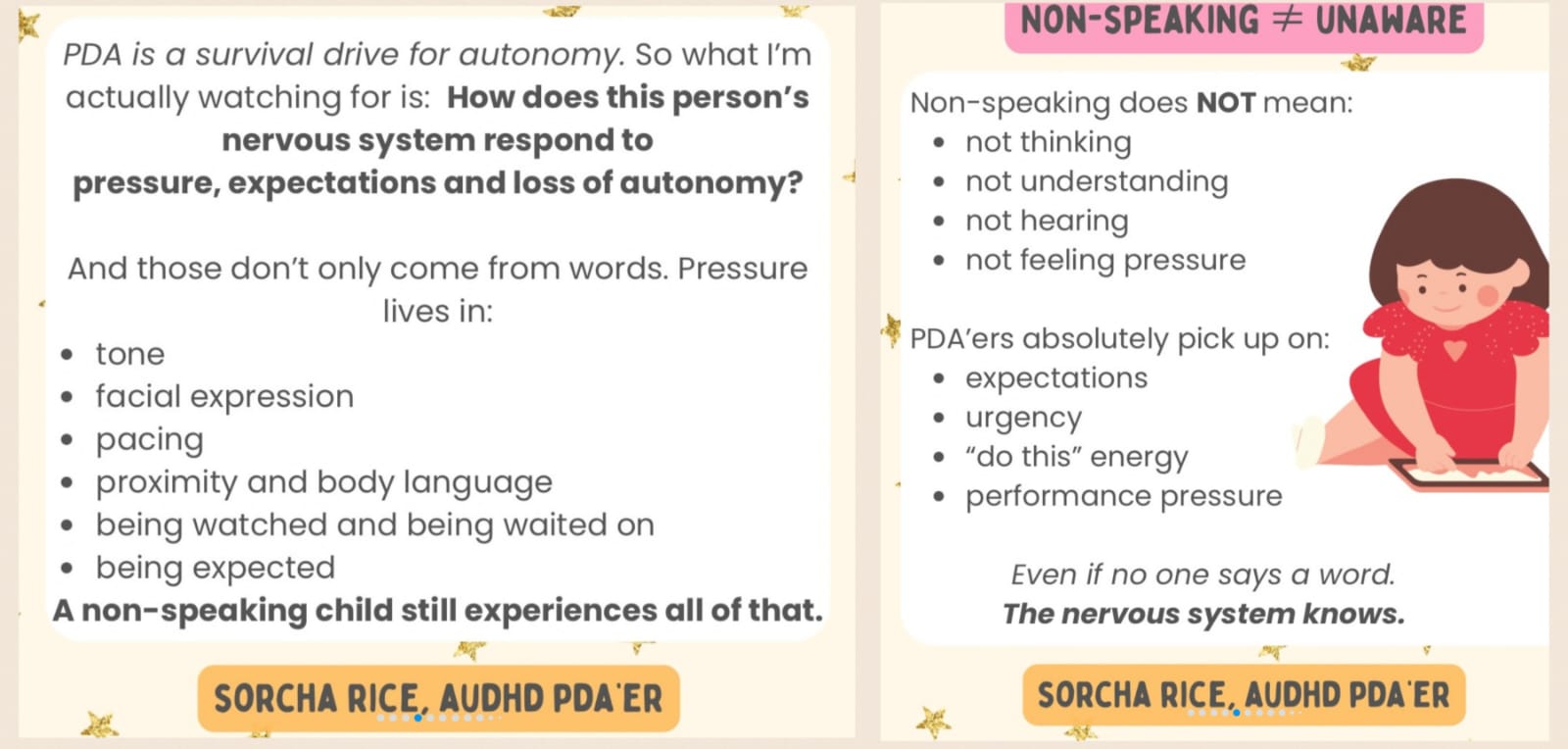
Many PDA triggers are not direct demands, but symbolic or sensory intrusions that the nervous system experiences as a loss of autonomy—moments where the environment appears to trespass into the self.
The “Plate” Trigger
Arthur had a meltdown because I used a plate that visually resembled his plate to eat khakra—a food he strongly dislikes for its crisp texture. Nothing was asked of him. Nothing was taken from him. Yet his nervous system experienced this as an autonomy breach:
- self-associated object appeared “misused”
- a disliked sensory experience was visually imposed
- control over symbolic boundaries was lost
This wasn’t about food. It was about ownership, identity, and uncontrollable sensory association. For PDA nervous systems, symbolism can function like a demand.
The Dead-Battery Standoff
When Arthur’s phone or iPad dies, it represents more than inconvenience. It is a sudden, external removal of control. Charging the device—something that appears logical to outsiders—can feel like submission to a system that already violated his autonomy. Refusal becomes a standoff, not defiance.
At that point, restoring power to the device does not feel regulating—it feels like agreeing to the loss.
My psychotherapist helped me understand that his behaviour is not irrational. It is a nervous system insisting on self-determination after forced loss. These triggers are often invisible to others because they operate at the level of meaning, association, and identity—not instruction.
What looks “irrational” from the outside is, internally, a clear signal: something about my world just moved without my consent.
When “Compliance” Is Actually a Safety Strategy
There are moments when Arthur appears compliant—particularly with his father around hygiene routines like brushing teeth or bathing. He allows his father to lead these tasks, yet strongly resists my involvement—pushing me away if I enter the washroom, refusing to let me touch his toothbrush, and clearly communicating that hygiene is something he wants only his father to manage.
Over time, the equalising shows up later—requesting that his father brush his teeth or give him a bath at 2 or 3 a.m., or suddenly in the middle of the afternoon.
On the surface, this can look confusing or even contradictory:
- Why can he tolerate this sometimes?
- Why only with one parent?
- Why does it later turn into refusal or control-seeking? - A neuroaffirming lens helps us see what’s really happening.
My therapist helped me name something important here: in these moments, Arthur may be prioritising connection over autonomy. His desire for undivided attention from his father is so strong that he is willing—temporarily—to loosen his grip on autonomy. His nervous system may still be activated, but his window of tolerance is wider in that relational context. The task is not neutral; it is buffered by safety, predictability, and deep attachment.
This is not true compliance. It is a nervous-system trade-off. And trade-offs carry a cost.
Over time, Arthur equalises by:
- requesting hygiene at unusual hours
- insisting that only one parent handle these tasks
This is not manipulation. It is repair.
His system is saying:
“If I gave something up earlier to stay safe, I need to restore balance now.”
The Mirror Side
From the mirror side, I recognise this too. There are moments when I appear cooperative or accommodating—not because my PDA is absent, but because connection, safety, or meaning temporarily expand my capacity. And later, my system finds quieter, delayed ways to rebalance.
Seen this way, these patterns are not inconsistencies to correct. They are maps of where safety, attachment, autonomy, and tolerance intersect—and where they momentarily fall out of alignment.
The iceberg holds both: the visible compliance above the waterline, and the invisible nervous-system negotiations happening below.
Equalising Is Not Regression — It’s Repair
In PDA, autonomy doesn’t disappear just because a child “managed” a demand earlier. It accumulates.
When autonomy is compromised—even gently, even through love and connection—the nervous system keeps score. Equalising later is how safety is restored.
This is why:
- a child may tolerate school all day and unravel at home
- a “good morning” turns into a hard evening
- a cooperative routine suddenly resurfaces at an unexpected hour
The demand didn’t disappear. It was held—until it couldn’t be anymore.
The Delayed Mirror: When I Froze and Advocated Later
That same need for autonomy surfaced for me in 2020 during a therapy session. Arthur’s occupational therapist used hand-over-hand assistance. As his hands were guided, Arthur escalated.
My own nervous system spiked—and I froze.
I wanted to say “stop.”
I wanted to protect his autonomy.
But my voice locked in my throat.
I couldn’t sleep that night. The weight of my silence pressed heavily on my body. At the time, I didn’t know I was a PDAer. I only knew something felt profoundly wrong.
I turned to the disabled community to understand the ethics of hand-over-hand support. Once my nervous system recovered, I wrote to the therapist—clearly, calmly, and firmly—about consent, body autonomy, and the right to refuse.
Only later did I understand the pattern:
Arthur equalises in the moment.
I equalise afterward.
Same nervous system need. Different timing.
For many PDAers, equalising may arrive late—through writing, advocacy, withdrawal, or collapse—once the nervous system is safe enough to respond.
The Cup Metaphor: Why the Reaction Rarely Matches the Moment
The cup metaphor helps explain this difference.
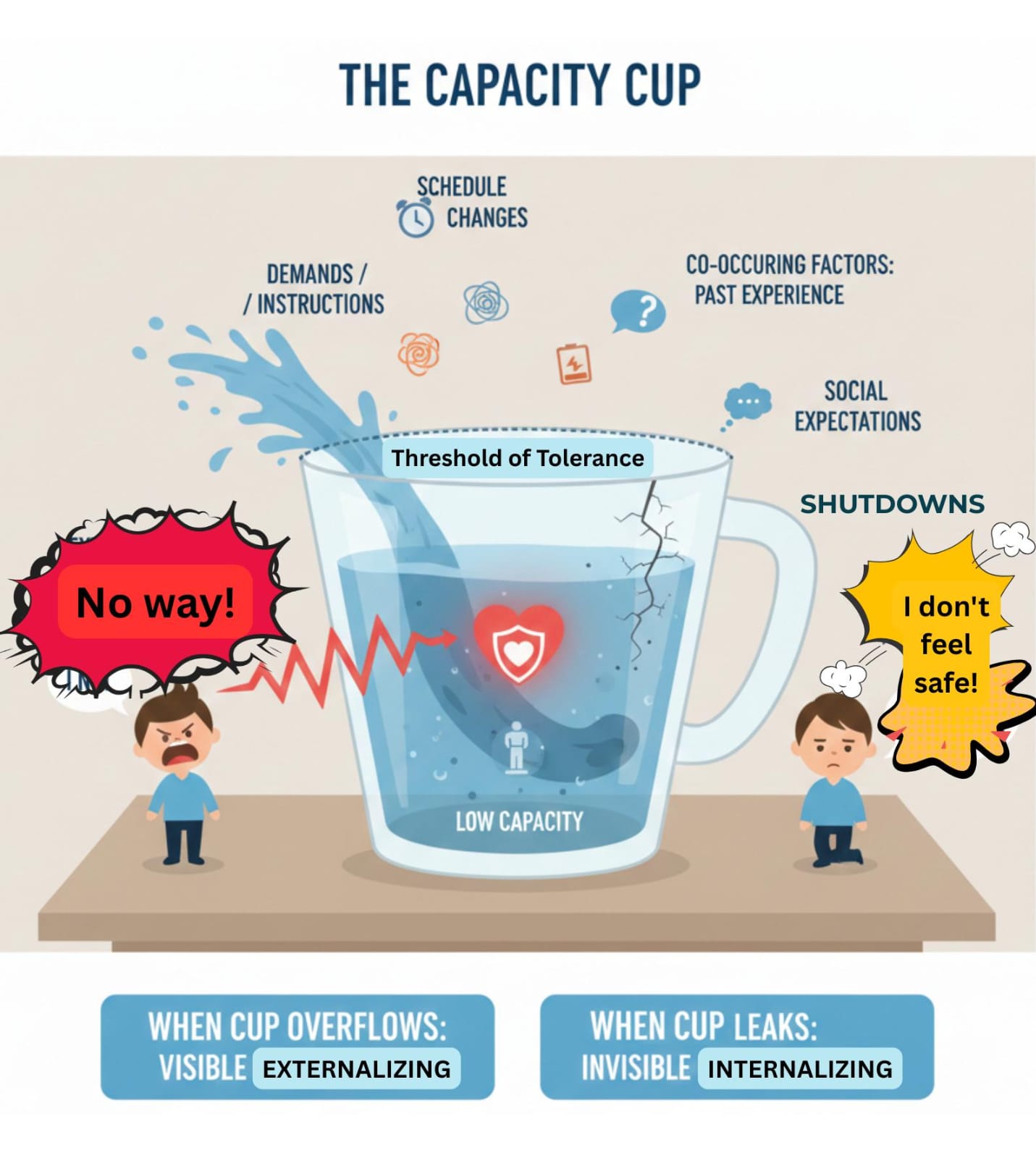
Each perceived loss of control adds a drop. Some drops are visible. Many are not. When the cup reaches its threshold, it spills.
On days when Arthur internalises, the cup fills quietly. On days when he externalises, the spill is visible and forceful.
The reaction is rarely about this moment. It’s about the accumulation.
Dr. Casey’s At Peace Parents explanation helped me understand this not just for Arthur, but for myself. On days when I internalise, my cup fills silently—through moral audits, social expectations, and subtle losses of agency.
Arthur often senses when my cup is nearing its threshold before I do.
The Remote Control: A Nervous System Rescue
One evening, while watching a spiritual video, the speaker said, “Don’t pray with unforgiveness in your heart.” Instantly, my nervous system went into a forced internal audit. Being told how to feel felt invasive. I tried to endure it.
Arthur didn’t.
He sensed the shift, took the remote, and replaced the video with his favourite Litany of the Blessed Virgin Mary—a melodic invitation rather than a moral demand.

The relief was immediate. My heart rate slowed. The ice began to thaw.
This wasn’t about control. This was co-regulation.
My therapist later helped me name what happened: Arthur wasn’t responding to the content; he was responding to **my physiology. ** By changing the environment, he moved us from performance-based safety to relational safety.
In some instances, he also takes away my phone when he senses that I am on the verge of breaking after reading triggering messages.
A Second Look at “Compliance”: What We Often Miss
Here’s where this matters deeply for parents and professionals.
Children who appear compliant are often praised, overlooked, or pushed further—because their distress is quiet. But quiet does not mean safe.
When a PDAer consistently copes by:
- masking
- freezing
- fawning
- surrendering autonomy temporarily for connection
the cost shows up later as:
- burnout
- sleep disruption
- physical illness
- sudden loss of skills
- a dramatic increase in “out of nowhere” resistance
This is how burnout is missed in “compliant-looking” PDAers. They don’t spill. They leak internally—until the system collapses.
A High-Cost Safety Strategy
This occurs when the nervous system suppresses the drive for autonomy to avoid the "threat" of disappointing a loved one. For a PDAer, a demand feels like a threat to their safety. However, if the person making the demand is a primary attachment figure (like a parent or spouse), the nervous system faces a paradox: “The demand makes me feel unsafe, but disappointing this person also makes me feel unsafe.”
Guilt-driven compliance is the nervous system choosing the "lesser" of two threats. It is a high-cost trade-off where a PDAer agrees to a demand—like Arthur agreeing to a task to please his father—while his internal system remains in a state of "no." This isn't true cooperation; it is a "borrowed" compliance that often leads to a delayed "after-burn" or total burnout later.
The Physiological Cost of Imposed Boundaries
When boundaries are imposed—by people, schedules, or environments—this isn’t a behavioural issue. It is a full-body response to a perceived loss of agency.
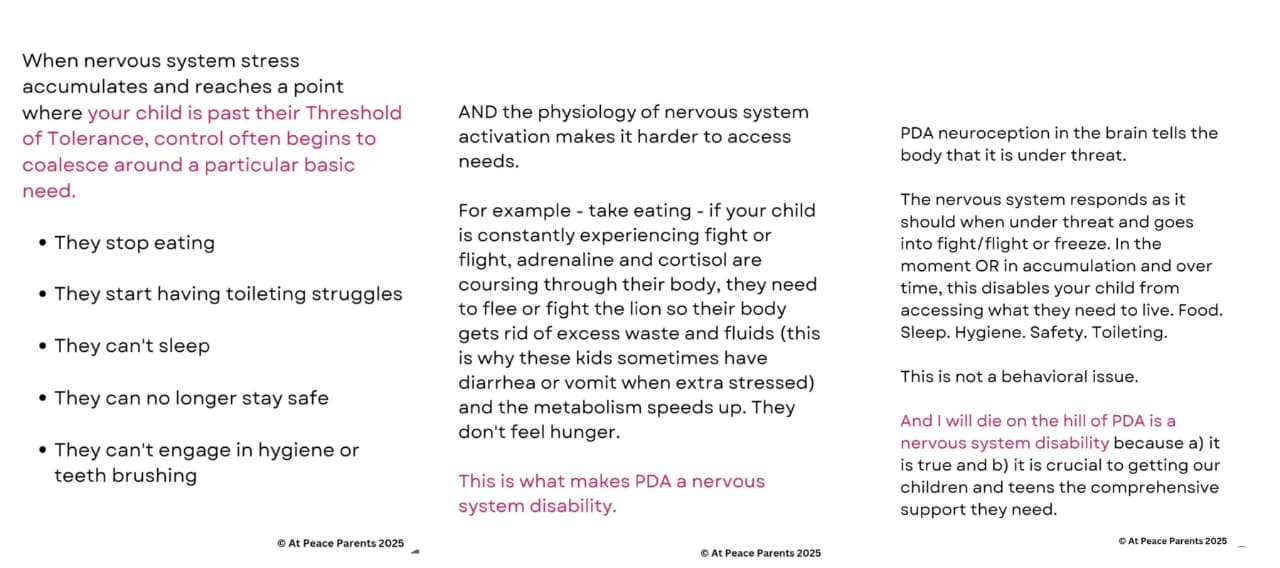
For Arthur, the impact is deeply physiological and often shows up as:
- Circadian disruption (Non-24)
- Physiological distress such as gagging
- Restrictive eating (ARFID+)
- The need for undivided attention
Arthur may become triggered if I speak to someone else, requiring my total presence to feel his environment is safe and co-regulated.
These are not behaviours to extinguish. They are the body speaking.
For PDAers like me, distress may show up as:
- situational mutism or fawn responses
- burnout, sleep disruption, or physical illness
- delayed advocacy or writing as a “late equaliser”
The F-Family: Fight, Flight, Freeze, Fawn, and Beyond
PDA nervous systems often respond with high-adrenaline reactions:
- Fight: active resistance, arguing, moving the world
- Flight: withdrawing, avoiding, escaping demands
- Freeze: temporary paralysis, silent standoff
- Fawn: over-compliance to preserve safety or connection
- Funster / Flop / Fib: lesser-known responses such as hiding feelings, joking to diffuse, or guilt-driven compliance
These are not different categories of PDA. They are different survival routes chosen by the same nervous system under different conditions.
The Mirror Iceberg: Parent and Child
Arthur’s PDA and mine operate on the same survival logic, but our nervous systems choose different strategies based on capacity, context, and safety.
A Gentle Reframe for Parents
If your child:
- complies sometimes
- resists later
- needs one specific person for a task
- unravels after holding it together
they are not being inconsistent.
They are managing a fluctuating nervous-system capacity.
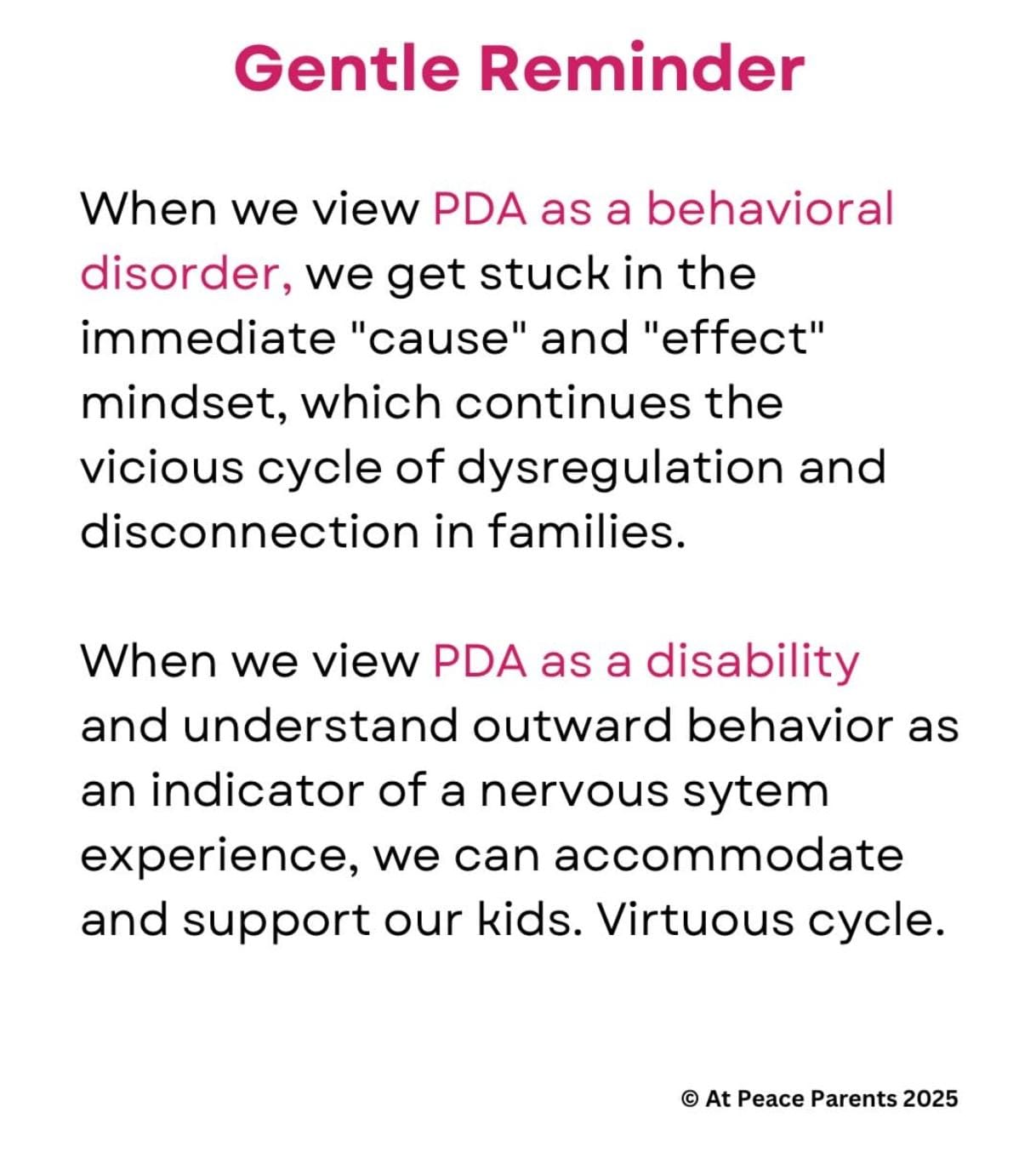
When we stop asking, “Why won’t they just…?”
and start asking, “How full is their cup right now?”
we move from behaviour management to nervous-system care.
And that shift changes everything. 💛
Author’s Note
This understanding of PDA, equalising, and nervous-system survival has been shaped in part through my work with my psychotherapist, whose support helped me name patterns that once felt confusing or self-blaming. I share these reflections with deep respect for the therapeutic process and gratitude for the clarity it brought.