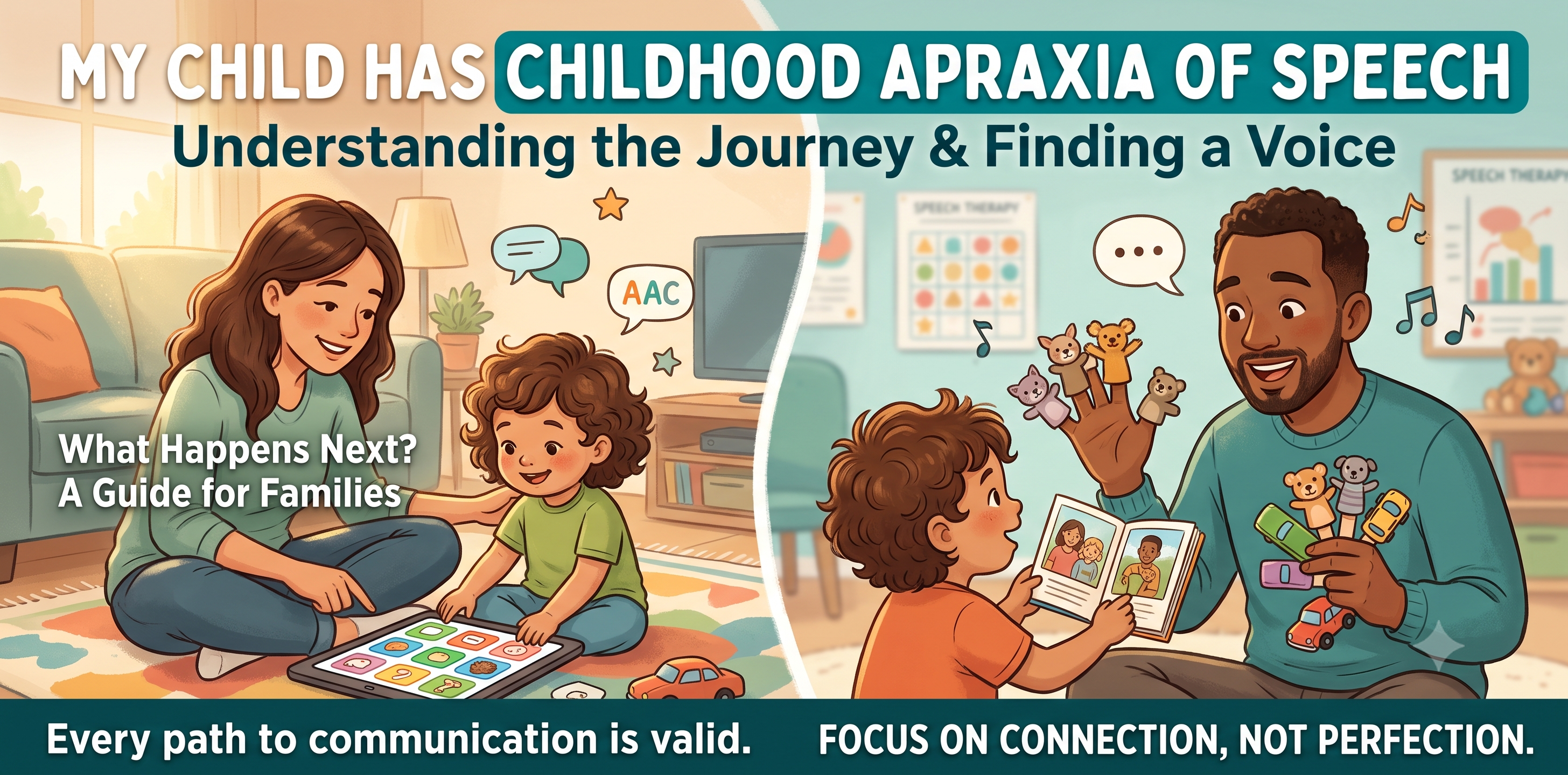

After a diagnosis of Childhood Apraxia of Speech (CAS) can bring many emotions. For some families, it is a relief to finally have an explanation. For others, it raises new questions and worries.
"What should we do now?"
"Will my child learn to speak?"
"How can I help at home?"
These are natural questions. The most important thing to remember is this:
A diagnosis is not a prediction of your child's future. It is simply a guide that helps us choose the right support.
Every child with apraxia has their own communication journey. Some become fluent speakers. Some use speech alongside other forms of communication. Others may rely on Augmentative and Alternative Communication (AAC) for some or all of their lives. Every path is valid because the goal is not perfect speech—the goal is meaningful communication.
Therapy Is About Building Skills, Not Fixing Your Child
As speech-language pathologists, we do not see children with apraxia as "broken."
Their brains simply need more opportunities to learn and practise the complex movements required for speech.
Think about learning to play a musical instrument. Knowing the tune is not enough—you need repeated practice to help your fingers move in the right way. Children with apraxia face a similar challenge when learning speech movements.
Therapy focuses on helping the brain plan, organise and produce speech movements more efficiently, while always respecting the child's pace, interests and wellbeing.
What Does Good Therapy Look Like?
Parents often imagine speech therapy as sitting at a table and repeating words over and over.
In reality, effective therapy is much more engaging.
Sessions often include:
- practising meaningful words your child uses every day
- learning through games and play
- using songs, rhythm and movement
- encouraging communication during favourite activities
- celebrating every successful attempt, no matter how small
The best therapy does not feel like a test. It feels like successful communication.
Progress Doesn't Always Look the Way You Expect
Many parents wait excitedly for the first clear words.
But progress often begins long before that.
You might notice your child:
- trying to communicate more often
- attempting longer words
- becoming less frustrated
- using gestures with more confidence
- looking at your face while trying to speak
- willingly joining communication activities
These are all meaningful signs of growth.
Every small step helps build the next one.
Your Child Does Not Need to Earn the Right to Communicate
One of the biggest misconceptions is that children should only use speech.
In reality, communication comes in many forms.
Your child may communicate using:
- speech
- gestures
- facial expressions
- signs
- pictures
- communication books
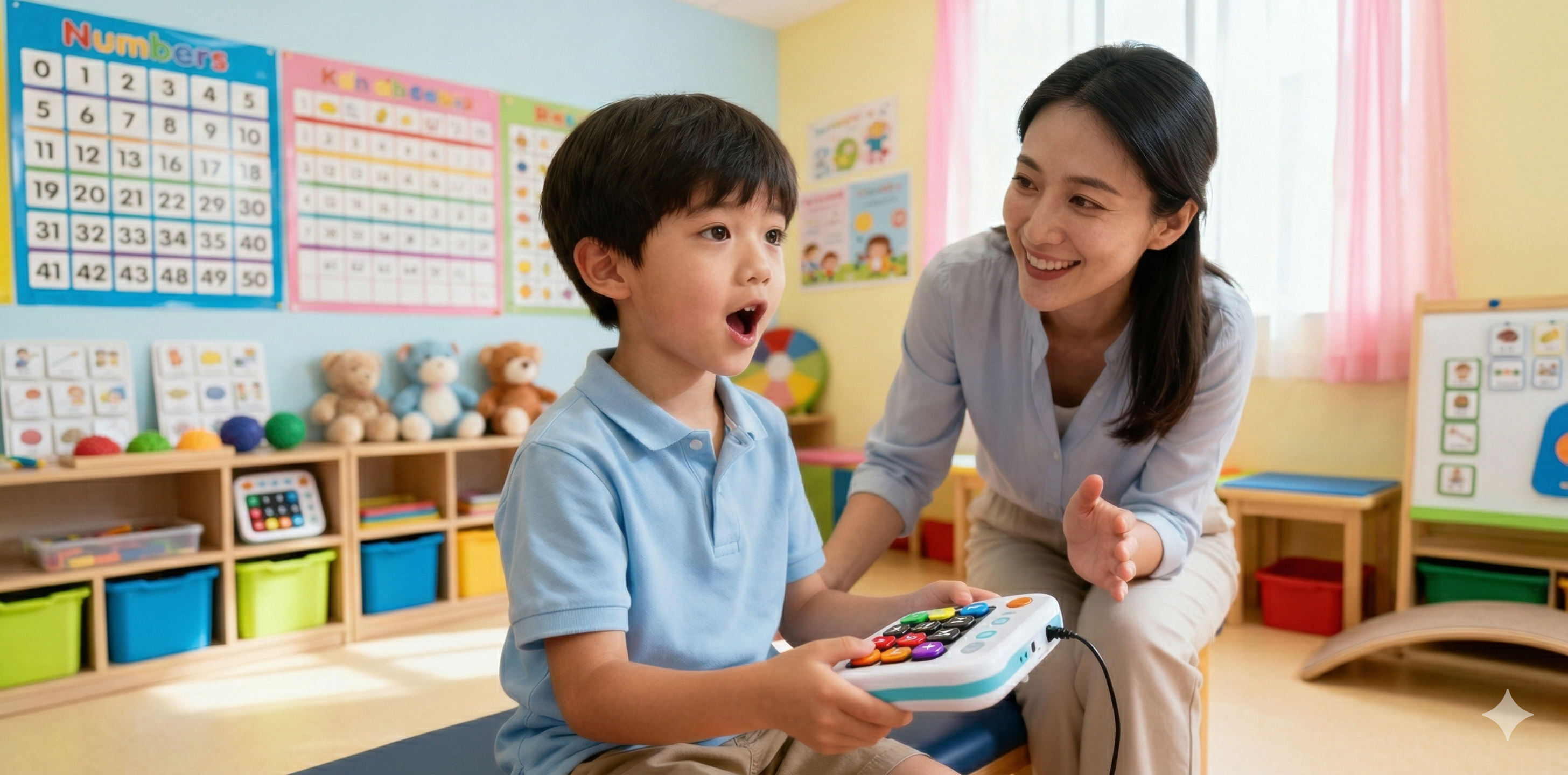
- AAC devices
Using AAC does not stop speech from developing.
Instead, it reduces frustration, allows children to express themselves, and gives them a reliable way to participate in everyday life while speech continues to develop.
Communication is the goal—not speech alone.
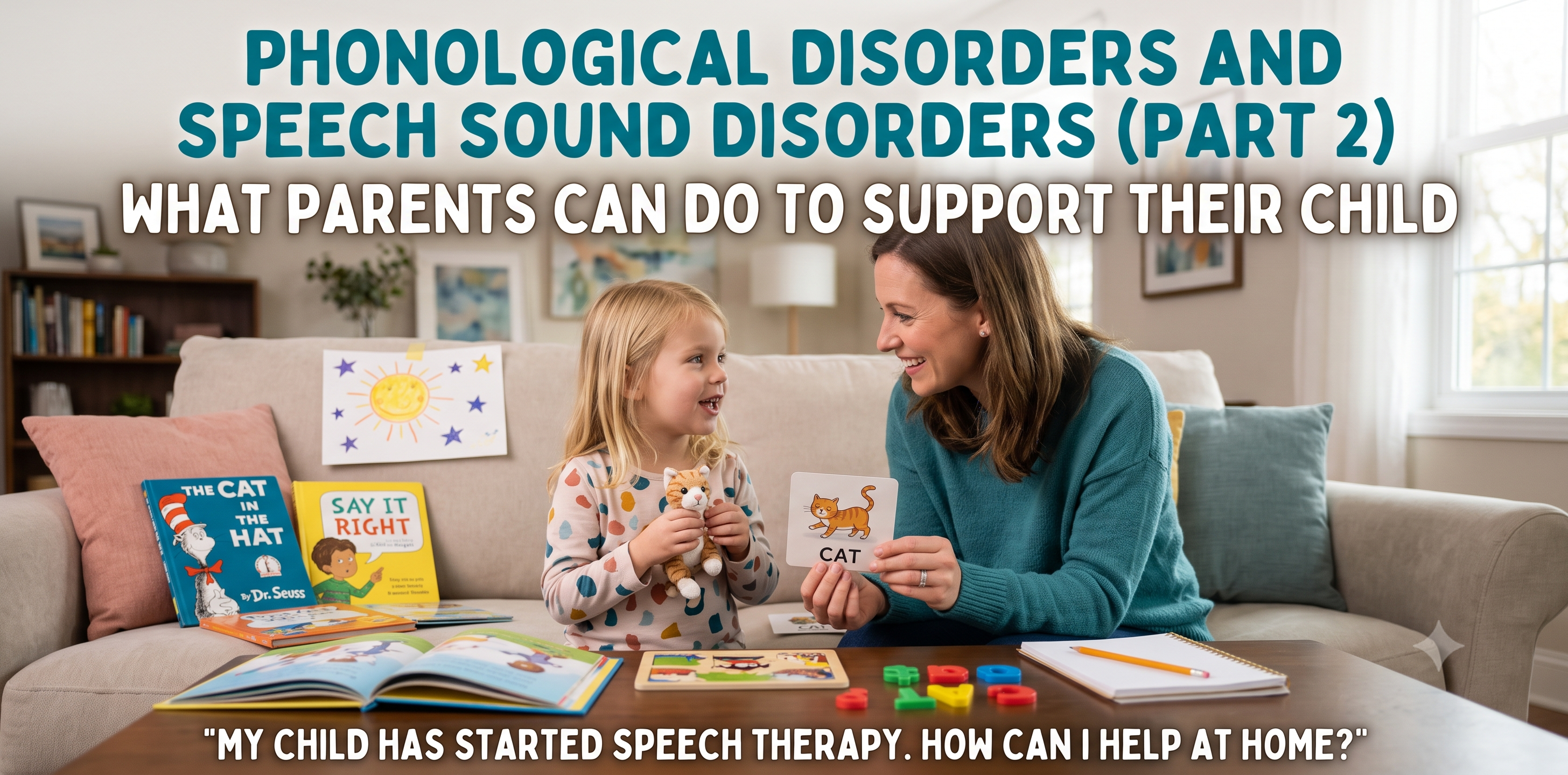
How Parents Can Help at Home
You do not need expensive materials or hours of practice.
Some of the best learning happens during ordinary moments.
Follow your child's lead
Talk about what they are interested in instead of directing every interaction.
If they are playing with cars, join them.
If they are fascinated by bubbles, make bubbles part of communication.
Motivation makes learning easier.
Focus on connection, not correction
Instead of correcting every mistake, respond to what your child is trying to communicate.
When children feel understood, they are more likely to keep trying.
Keep practice short
Five to ten minutes of enjoyable practice is often more helpful than one long session.
Stop while your child is still engaged.
Positive experiences encourage future communication.
Celebrate attempts
Whether your child says a sound, points to a picture, signs a word or uses an AAC device, acknowledge the effort.
Every attempt is communication.
Every attempt deserves a response.
What Parents Don't Need to Do
You don't need to ask your child to repeat a word until they "get it right."
You don't need to compare them with other children.
You don't need to worry if progress seems slow.
Learning new speech movements takes time, and every child progresses differently.
Trust the process and celebrate the small wins.
Looking Beyond Speech
Children with apraxia are much more than their speech.
They are artists, builders, dancers, thinkers, explorers, comedians, scientists and storytellers.
Their ability to communicate may look different, but their thoughts, feelings and ideas are just as important as anyone else's.
Our responsibility is not to change who they are.
It is to make sure they have a voice—whatever form that voice takes.
A Final Thought
As parents, it is easy to become focused on milestones, words and therapy goals.
But your child needs something even more important.
They need to know that they are loved, understood and accepted exactly as they are today—not only when they speak more clearly tomorrow.
The greatest gift you can give your child is a home where communication is celebrated in every form.
Because every child deserves to be heard, whether through speech, signs, pictures, gestures or technology.
When we value communication over perfection, we create space for children with apraxia to thrive—not by becoming someone else, but by becoming more fully themselves.
.png)