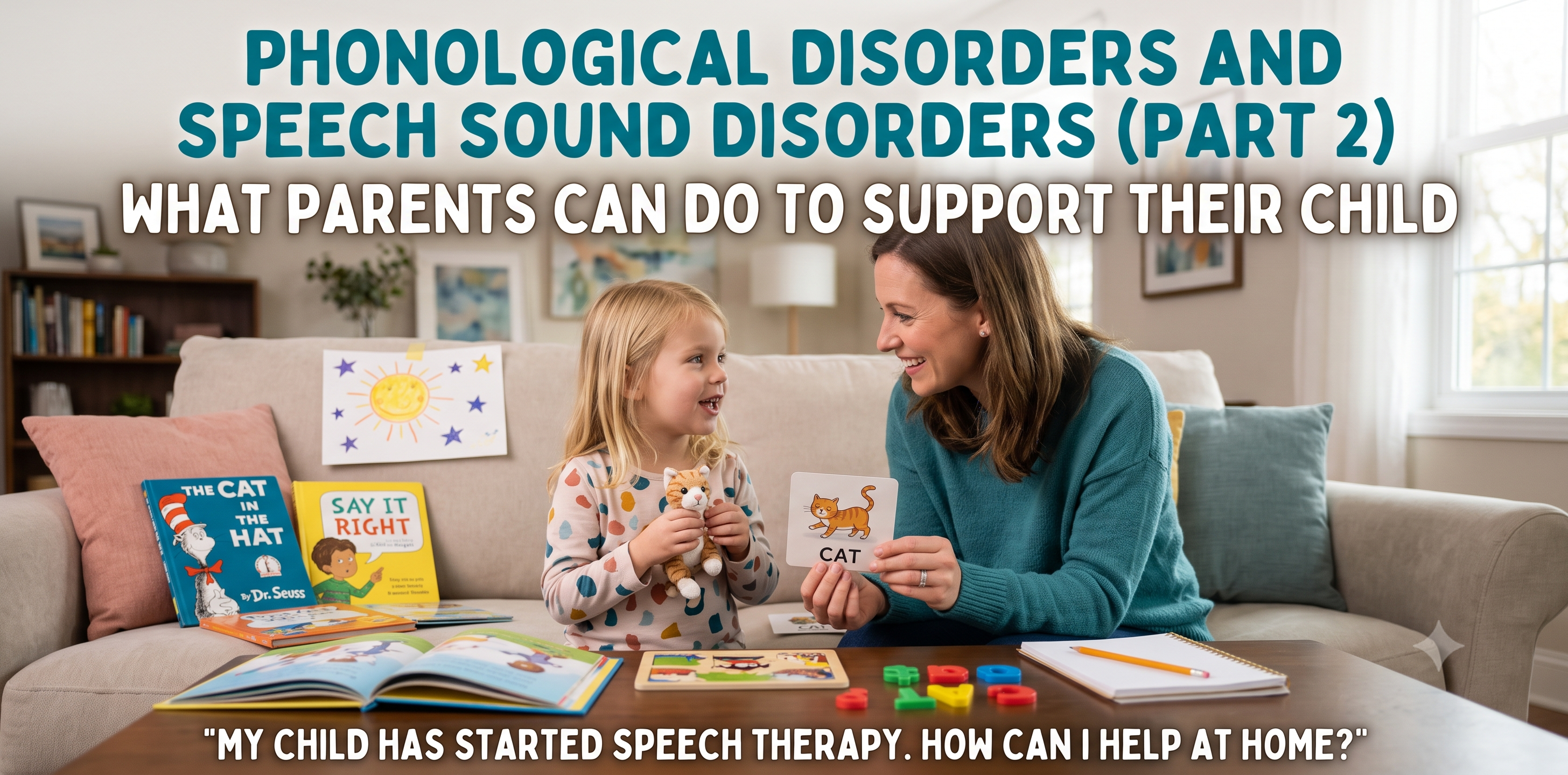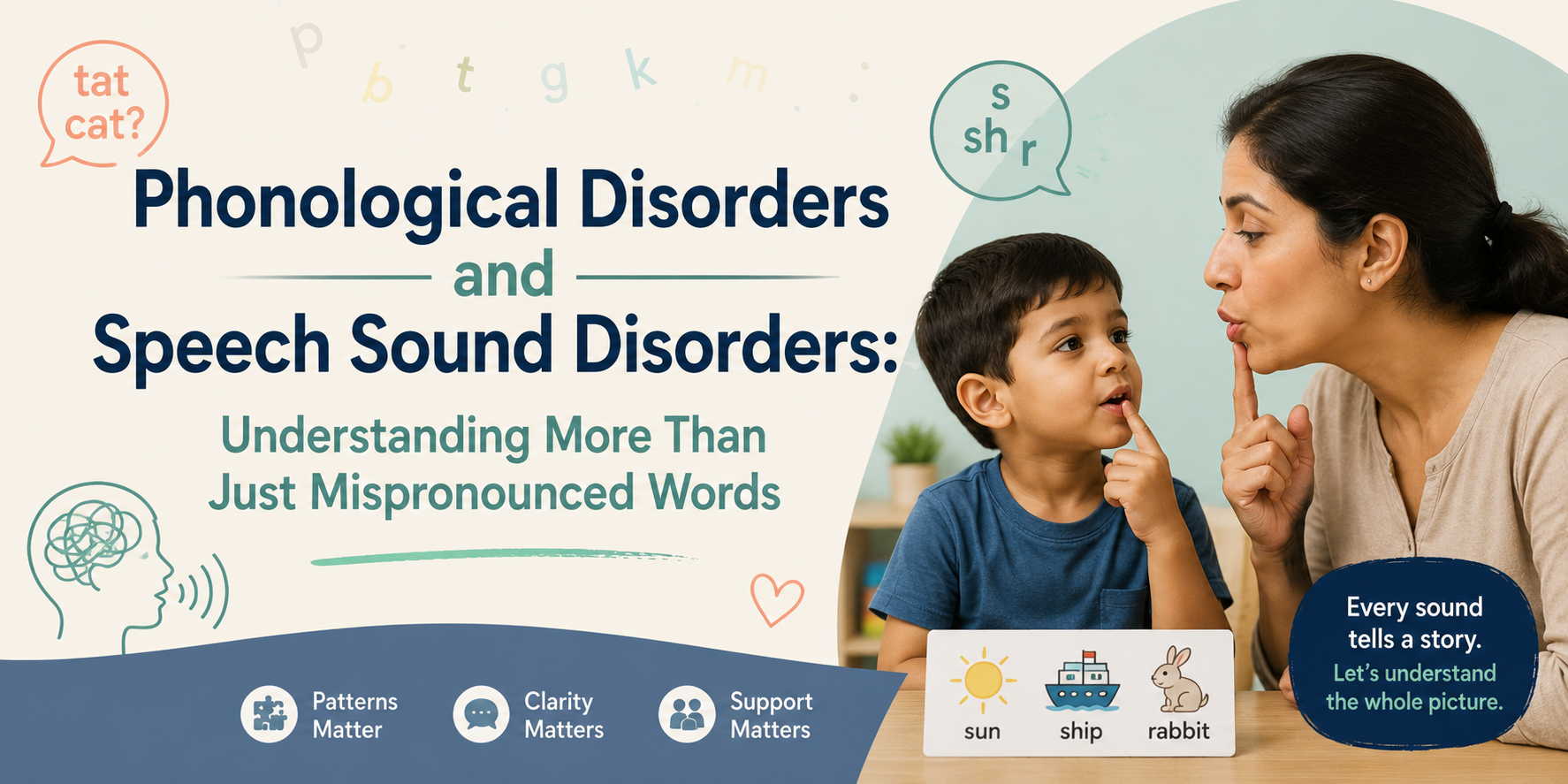

"My child says 'tat' instead of 'cat.' Is this normal?"
Many parents notice that their child does not pronounce words clearly during the early years of speech development. While some speech errors are a natural part of learning to talk, others may persist beyond the expected age or affect a child's ability to communicate effectively. It can be difficult for parents to know the difference between a developmental speech error and a speech disorder.
One of the most common areas of confusion is the difference between Speech Sound Disorders (SSD) and Phonological Disorders. These terms are often used interchangeably, but they are not the same. Understanding the distinction is the first step toward getting the right support for your child.
What Are Speech Sound Disorders?
Speech Sound Disorder is an umbrella term that refers to any difficulty producing speech sounds correctly. Children with SSD may have trouble saying certain sounds, combining sounds into words, or using sounds consistently when they speak.
Speech Sound Disorders generally include:
- Articulation disorders
- Phonological disorders
- Childhood Apraxia of Speech (CAS)
- Speech difficulties associated with structural or neurological conditions
Each of these affects speech in a different way and therefore requires a different therapeutic approach.
What Is a Phonological Disorder?
A phonological disorder is a type of Speech Sound Disorder where the child has difficulty understanding and using the sound rules of a language.
Instead of struggling to physically produce a sound, the child is able to make the sound but does not use it correctly in words. The difficulty lies in organising speech sounds into meaningful patterns.
For example:
- Saying "tat" instead of "cat"
- Saying "doe" instead of "go"
- Saying "poon" instead of "spoon"
In these examples, the child can often produce the sounds K, G, or S individually but replaces or omits them when speaking in words.
This is different from an articulation disorder, where the child cannot physically produce a particular sound correctly.
What Are Phonological Processes?
As children learn language, they naturally simplify words to make them easier to pronounce. These simplifications are called phonological processes and are completely normal during early development.
Examples include:
- Fronting: Saying "tat" for "cat"
- Stopping: Saying "tun" for "sun"
- Final consonant deletion: Saying "ca" for "cat"
- Cluster reduction: Saying "pane" for "plane"
Most children gradually stop using these patterns as their speech develops. When these patterns continue beyond the expected age or occur frequently enough to affect intelligibility, they may indicate a phonological disorder.
Signs That May Indicate a Phonological Disorder
Every child develops differently, but some signs may suggest that an assessment by a Speech-Language Pathologist is beneficial.
These include:
- Speech that is difficult for unfamiliar listeners to understand.
- Using the same speech errors repeatedly across many different words.
- Omitting or replacing several speech sounds.
- Speech that does not improve as expected with age.
- Frustration while trying to communicate.
- Difficulty being understood in preschool or school settings.
Children are often aware when others cannot understand them, which may affect their confidence and willingness to participate in conversations.
Why Do Phonological Disorders Occur?
In many children, there is no single identifiable cause.
However, phonological disorders may be associated with:
- Family history of speech or language difficulties
- Delayed language development
- Hearing difficulties, especially recurrent ear infections
- Neurodevelopmental differences
- Unknown developmental factors
It is important to remember that a phonological disorder is not caused by poor parenting, bilingualism, or laziness. Children are not choosing to speak this way - they require support to learn the sound system of their language.
How Are Speech Sound Disorders Assessed?
A Speech-Language Pathologist conducts a detailed assessment to understand the nature of the child's speech difficulty.
The assessment may include:
- Oral mechanism examination
- Speech sound assessment
- Analysis of phonological error patterns
- Language assessment when appropriate
- Hearing history and referral if needed
- Evaluation of speech intelligibility in conversation
Rather than focusing only on individual sounds, the clinician looks at the overall pattern of speech to determine whether the child has an articulation disorder, a phonological disorder, or another type of Speech Sound Disorder.
How Does Speech Therapy Help?
Speech therapy is highly effective for most children with phonological disorders when intervention is individualised and evidence-based.
Therapy focuses on helping the child:
- Learn the sound patterns of their language.
- Recognise differences between speech sounds.
- Produce sounds accurately in words and sentences.
- Generalise correct speech into everyday conversations.
- Improve overall speech intelligibility.
Depending on the child's needs, therapy may use approaches such as:
- Minimal Pair Therapy
- Multiple Oppositions Therapy
- Cycles Approach
- Metaphon Therapy
- Core Vocabulary Approach
The choice of therapy depends on the child's speech profile rather than simply the number of sounds they mispronounce.
Can Children Outgrow a Phonological Disorder?
Some developmental speech errors disappear naturally as children mature. However, persistent phonological disorders generally require intervention.
Without appropriate therapy, children may continue to experience:
- Reduced speech intelligibility
- Difficulties with reading and spelling
- Lower confidence when speaking
- Challenges in classroom participation
- Social communication difficulties
Early identification allows children to develop clearer speech before these challenges become more significant.
When Should Parents Seek Help?
Consider consulting a Speech-Language Pathologist if:
- Your child is difficult to understand compared to other children of the same age.
- They continue using immature speech patterns beyond the expected developmental age.
- Teachers or caregivers have concerns about speech clarity.
- Your child becomes frustrated because others cannot understand them.
- You simply feel uncertain about whether their speech is developing appropriately.
Trusting your instincts as a parent is important. A professional assessment can either reassure you that development is on track or identify areas where early support may be helpful.
To conclude,
Every child deserves to be understood.
Speech is more than producing individual sounds - it is about using those sounds to communicate thoughts, ideas, emotions, and experiences. Children with phonological disorders are capable communicators, but the sound system they use needs support to develop.
With early assessment, evidence-based intervention, and consistent practice, most children make significant progress and become clearer, more confident communicators.
If you have concerns about your child's speech, remember that seeking an assessment is not about labelling your child. It is about understanding their communication needs and giving them the opportunity to express themselves with confidence.
Because every child has a unique speech profile, there is no one-size-fits-all approach. The earlier support begins, the greater the opportunity to build strong communication skills that benefit learning, relationships, and everyday life.
.png)