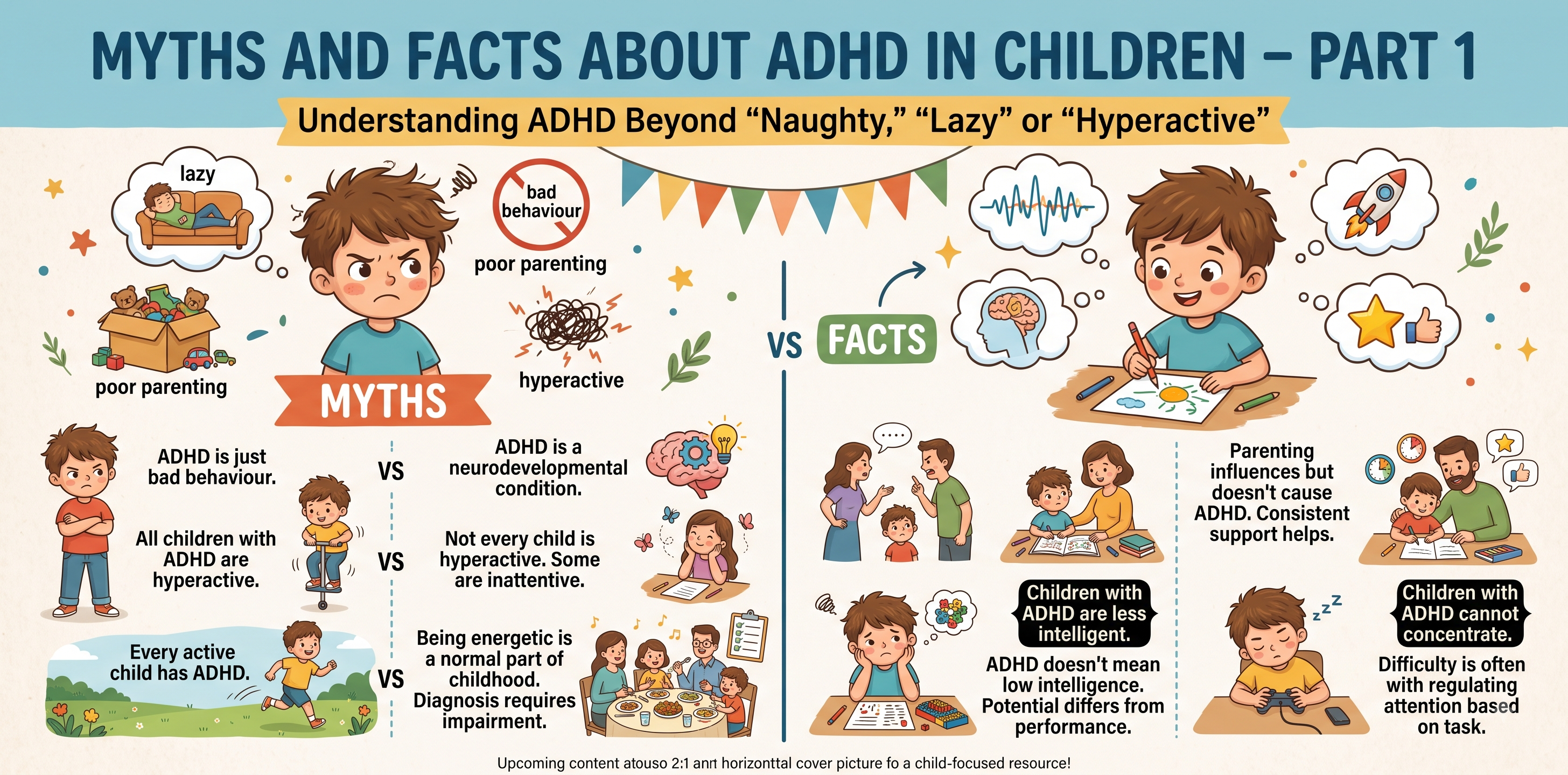

Understanding ADHD Beyond “Naughty,” “Lazy” or “Hyperactive”
“My child cannot sit still. Does that mean they have ADHD?”
This is one of the common questions parents ask when they notice that their child is constantly moving, getting distracted, interrupting others, forgetting instructions, or having difficulty completing tasks.
Attention-Deficit/Hyperactivity Disorder, commonly known as ADHD, is frequently discussed, but it is also one of the most misunderstood neurodevelopmental conditions in childhood.
Some people believe that ADHD is simply a result of poor parenting. Others think that every active child has ADHD. Some believe that children with ADHD are lazy, less intelligent, or simply unwilling to listen. But ADHD is much more complex than that. ADHD is a neurodevelopmental condition associated with persistent difficulties with attention, hyperactivity and/or impulsivity that can affect a child’s everyday functioning.
It can influence learning, relationships, behaviour, emotional regulation, organisation and participation in daily activities.
At the same time, being energetic, distracted or occasionally impulsive does not automatically mean that a child has ADHD.
So, how do we separate what we commonly hear from what the evidence actually tells us?
Let us look at some of the most common myths.
Myth 1: “ADHD is just bad behaviour.”
Fact: ADHD is a neurodevelopmental condition, not simply a behaviour problem.
Children with ADHD may have difficulty sustaining attention, controlling impulses, regulating activity levels and managing tasks that require prolonged mental effort.
These difficulties can sometimes look like intentional misbehaviour.
For example, a child may be asked to complete homework and repeatedly get up from the chair, lose their pencil, forget the instructions, start another activity or become distracted by something happening around them.
A parent may understandably think:
“They know what they are supposed to do. Why don’t they just do it?”
But knowing what to do and being able to consistently regulate behaviour are not always the same thing.
Current evidence supports ADHD as a neurodevelopmental condition rather than simply a consequence of poor discipline or parenting.
This does not mean that children with ADHD do not need boundaries.
They do.
However, boundaries and behavioural strategies work best when they are combined with an understanding of the child’s difficulties.
Instead of only asking:
“How do I stop this behaviour?”
we can also ask:
“What is making this behaviour difficult for the child to regulate?”
That change in perspective can make a significant difference.
Myth 2: “All children with ADHD are hyperactive.”
Fact: Not every child with ADHD is noticeably hyperactive.
When people hear ADHD, they often imagine a child who is constantly running around, climbing on furniture and unable to sit still.
But ADHD does not look the same in every child.
Some children primarily experience difficulties with inattention.
They may:
- Daydream frequently
- Lose school materials
- Forget instructions
- Have difficulty completing tasks
- Make careless mistakes
- Struggle to organise their work
- Appear as though they are not listening
- Become easily distracted
Other children may show more obvious hyperactive and impulsive behaviours.
Some children show a combination of inattentive, hyperactive and impulsive symptoms.
This is important because a child does not have to be constantly running around for their difficulties to be taken seriously.
Research also indicates that ADHD presentation can differ between children, and inattentive symptoms may contribute to under-recognition in some groups, particularly girls.
So, a quiet child who frequently forgets instructions, loses materials or struggles with organisation should not automatically be assumed to have no attention difficulties.
Myth 3: “Every active child has ADHD.”
Fact: Being energetic or occasionally distracted is a normal part of childhood.
Children are naturally curious.
They move.
They explore.
They become distracted.
They lose interest.
They sometimes interrupt.
These behaviours alone do not mean that a child has ADHD.
For ADHD to be considered, difficulties need to be persistent and associated with meaningful impairment in everyday functioning.
A child who is unable to sit through one long activity but functions well across other settings may simply have an age-appropriate attention span or a different activity level.
On the other hand, if difficulties with attention, impulsivity or activity level are persistent and interfere with school, home or social functioning, further evaluation may be appropriate.
This distinction is important because one behaviour does not diagnose ADHD.
Myth 4: “ADHD happens because parents do not discipline their children properly.”
Fact: Parents do not cause ADHD by being too strict or too lenient.
This myth can be particularly painful for parents.
They may hear comments such as:
“If you were stricter, the child would behave.”
or
“You are giving the child too much freedom.”
Parenting certainly influences a child’s environment and behaviour.
However, ADHD itself should not be reduced to a parenting problem.
A child with ADHD may still benefit from consistent routines, clear expectations, predictable consequences and positive reinforcement.
But these strategies are supportive interventions, not evidence that the parents caused the child’s condition.
Parents also need support rather than blame.
When a child struggles with self-regulation and the parent is constantly trying to manage those difficulties, both can become frustrated.
Understanding the child’s needs can help break this cycle.
Myth 5: “Children with ADHD are less intelligent.”
Fact: ADHD does not mean that a child has low intelligence.
This is one of the misconceptions that can have a lasting effect on a child’s confidence.
A child with ADHD may be intelligent, creative, curious and highly capable.
However, their performance may not always reflect their abilities.
For example, a child may understand a concept during classroom discussion but fail to complete the worksheet because they become distracted.
Another child may know the answer but rush through the task and make avoidable mistakes.
Another may have excellent ideas but struggle to organise those ideas into a written assignment.
This can create a frustrating gap between:
“What the child knows”
and
“What the child is able to demonstrate consistently.”
Instead of asking:
“Why is this child not performing to their potential?”
we can ask:
“What is making it difficult for this child to demonstrate what they know?”
That is a very different question.
And sometimes, it leads us towards a much more helpful answer.
Myth 6: “Children with ADHD cannot concentrate.”
Fact: Children with ADHD can concentrate. The difficulty is often with regulating attention.
This is one of the most misunderstood aspects of ADHD.
Parents sometimes say:
“He can play a video game for two hours, so how can he have attention problems?”
The answer is that ADHD is not necessarily an inability to pay attention to anything.
A child may be able to spend a long time doing something that is highly interesting, stimulating or rewarding but struggle to sustain attention during a less motivating task.
For example:
A child may spend an hour building something they love but struggle to complete a 15-minute homework activity.
This does not necessarily mean that the child is deliberately choosing when to pay attention.
The demands of the task matter.
The environment matters.
The level of stimulation matters.
The child’s ability to organise and regulate their attention matters.
Therefore, instead of thinking:
“My child can concentrate, so they cannot have ADHD.”
it may be more useful to think:
“What kinds of activities are easier or harder for my child to regulate their attention during?”
That question can give us much more useful information.
What Should Parents Take Away From Part 1?
ADHD is more than being naughty, lazy, hyperactive or distracted.
At the same time, not every energetic or forgetful child has ADHD.
Both extremes can be harmful.
We should not label every active child as having ADHD.
But we should also not dismiss persistent difficulties as simply bad behaviour.
The most helpful approach is to observe the child with curiosity rather than judgement.
Ask:
What is the child finding difficult?
When does the difficulty occur?
How does it affect everyday life?
What support could make participation easier?
And most importantly:
What does this child need to succeed?
In Part 2, we will look at some of the other common myths surrounding ADHD, including myths about screen time, medication, diagnosis, treatment, intelligence, and whether children “grow out of” ADHD.
.png)