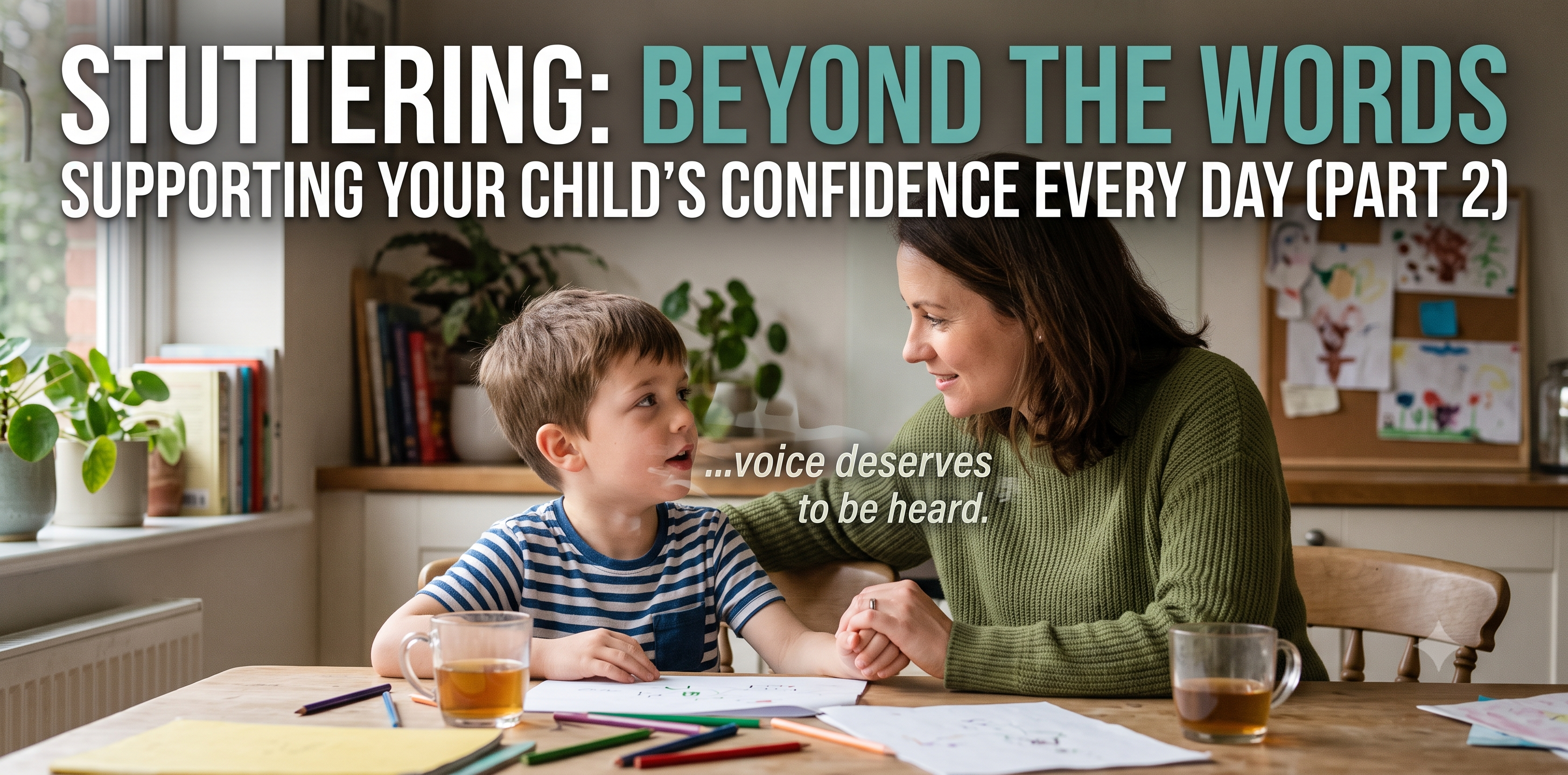

“My child has started repeating words. Should I be worried?”
This is one of the most common questions parents ask a Speech-Language Pathologist.
Hearing your child struggle to get words out can be worrying. You may wonder if it is “just a phase” or if they will always have difficulty speaking.
The first thing I want you to know is this:
Stuttering is nobody’s fault.
It is not caused by poor parenting, nervousness, excitement, or a child speaking too fast. Stuttering is a neurodevelopmental difference that affects the flow of speech. With the right support, children who stutter can become confident communicators.
As a neurodiversity-affirming Speech-Language Pathologist, I believe that the goal is not simply to make a child “fluent.” The goal is to help them communicate confidently, participate fully, and know that their voice matters.
What Is Stuttering?
Stuttering is a difference in the way speech flows.
A child who stutters may:
- repeat sounds, syllables, or words (“b-b-ball”)
- stretch out sounds (“ssssssun”)
- get “stuck” before a word comes out
- pause for longer than expected while trying to speak
These moments are called disfluencies.
Some children may also blink, move their head, or show signs of effort while trying to get a word out. These are often natural responses to the difficulty they are experiencing, not behaviours they choose.
Isn’t It Normal for Young Children to Repeat Words?
Yes. Many children between the ages of 2 and 5 years go through a period of normal disfluency as their language develops rapidly. They might repeat whole words or phrases occasionally, especially when they are excited or trying to express complex ideas.
However, if the repetitions become frequent, involve sounds or syllables, or your child seems frustrated or aware of the difficulty, it is a good idea to consult a Speech-Language Pathologist.
Early guidance can make a significant difference.
What Causes Stuttering?
There is no single cause.
Research suggests that stuttering results from a combination of factors, including:
- differences in how the brain processes speech
- genetics (it often runs in families)
- individual developmental differences
What does not cause stuttering?
- Poor parenting
- Being shy
- Anxiety
- Emotional weakness
- Intelligence
- Speaking two languages
These are common myths that deserve to be left behind.
What Should Parents Do?
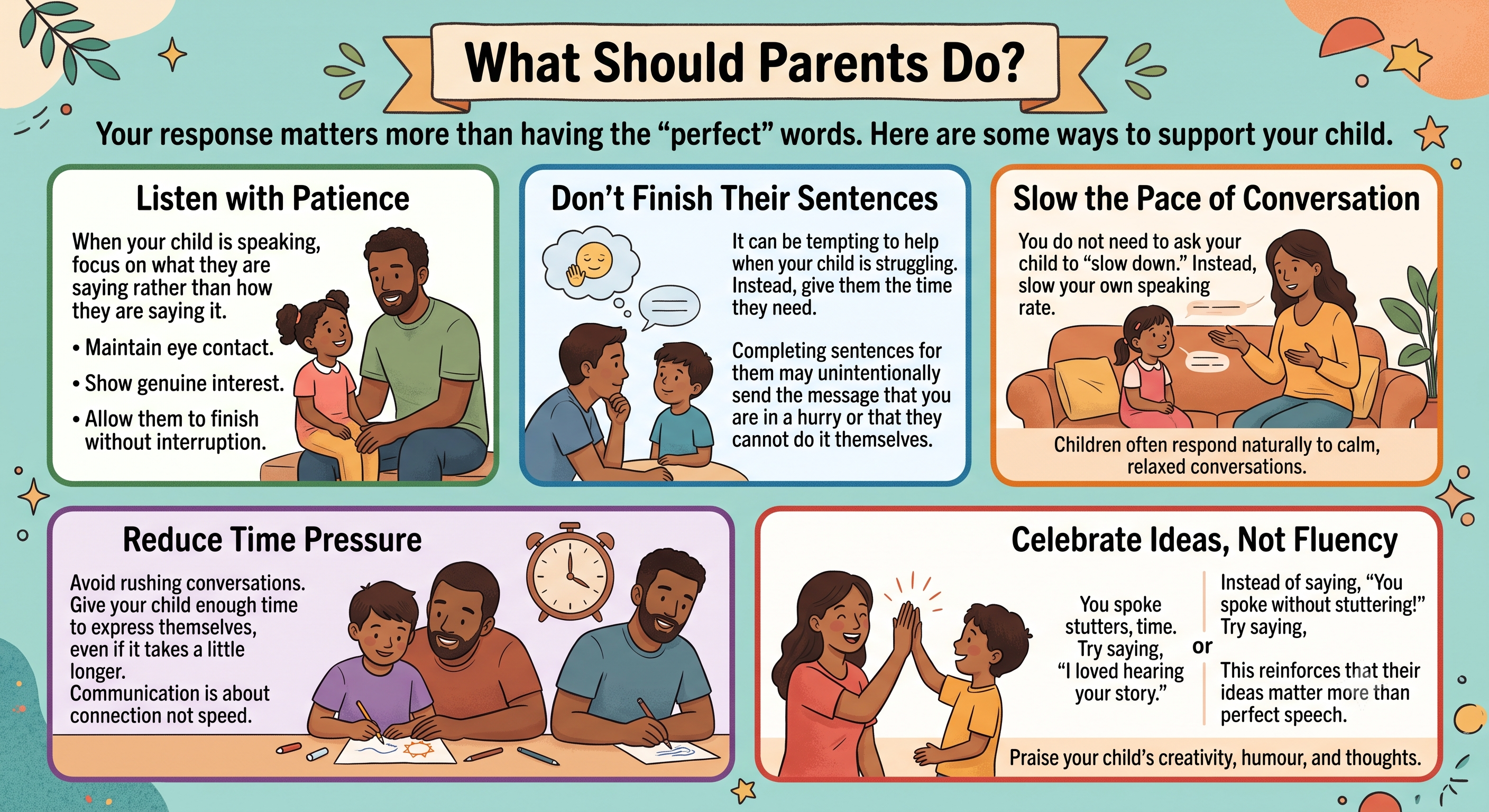
Your response matters more than having the “perfect” words. Here are some ways to support your child.
Listen with Patience
When your child is speaking, focus on what they are saying rather than how they are saying it.
- Maintain eye contact.
- Show genuine interest.
- Allow them to finish without interruption.
Don’t Finish Their Sentences
It can be tempting to help when your child is struggling. Instead, give them the time they need.
Completing sentences for them may unintentionally send the message that you are in a hurry or that they cannot do it themselves.
Slow the Pace of Conversation
You do not need to ask your child to “slow down.” Instead, slow your own speaking rate.
Children often respond naturally to calm, relaxed conversations.
Reduce Time Pressure
Avoid rushing conversations. Give your child enough time to express themselves, even if it takes a little longer. Communication is about connection not speed.
Celebrate Ideas, Not Fluency
Praise your child’s creativity, humour, and thoughts.Instead of saying,
“You spoke without stuttering!”
Try saying,
“I loved hearing your story.”
This reinforces that their ideas matter more than perfect speech.
Things to Avoid
Well-meaning advice can sometimes make children feel more self-conscious.
Try to avoid saying:
- “Slow down.”
- “Take a deep breath.”
- “Think before you speak.”
- “Relax.”
- “Start again.”
Although these comments are intended to help, they often increase pressure rather than reduce it.
Does My Child Need Therapy?
Not every child who stutters will need therapy.
However, an assessment is recommended if:
- stuttering has continued for several months
- it is becoming more frequent
- your child appears frustrated or avoids speaking
- there is a family history of persistent stuttering
- you are worried as a parent
A Speech-Language Pathologist can help determine whether monitoring, parent guidance, or direct therapy is the most appropriate next step.
What Happens in Therapy?
Therapy is not about forcing children to speak perfectly.
Instead, it helps children:
- communicate with confidence
- reduce fear around speaking
- develop positive communication experiences
- learn strategies that support comfortable communication
Parents are an important part of therapy because communication happens throughout everyday life not just during clinic sessions.
Building Confidence Is Just as Important as Building Fluency
Some children who stutter become excellent speakers, teachers, actors, lawyers, scientists, entrepreneurs, and leaders.
What helped them succeed was not simply becoming more fluent.
It was growing up believing that their voice was valuable.
Children who know they are accepted are more likely to participate in conversations, answer questions, make friends, and express their opinions.
Confidence lasts much longer than perfect fluency.
A Final Message for Parents
If your child stutters, remember this:
Your child does not need to hide their speech or apologise for it.
They need people who will listen patiently, encourage them, and remind them that what they say is far more important than how smoothly they say it.
Your calm presence, your acceptance, and your willingness to listen are powerful forms of support.
Every child deserves to be heard.
Not because they speak perfectly, but because every voice has value.

.png)