
When people hear the word autism, they often picture one type of child. But autism is called a spectrum for a reason.
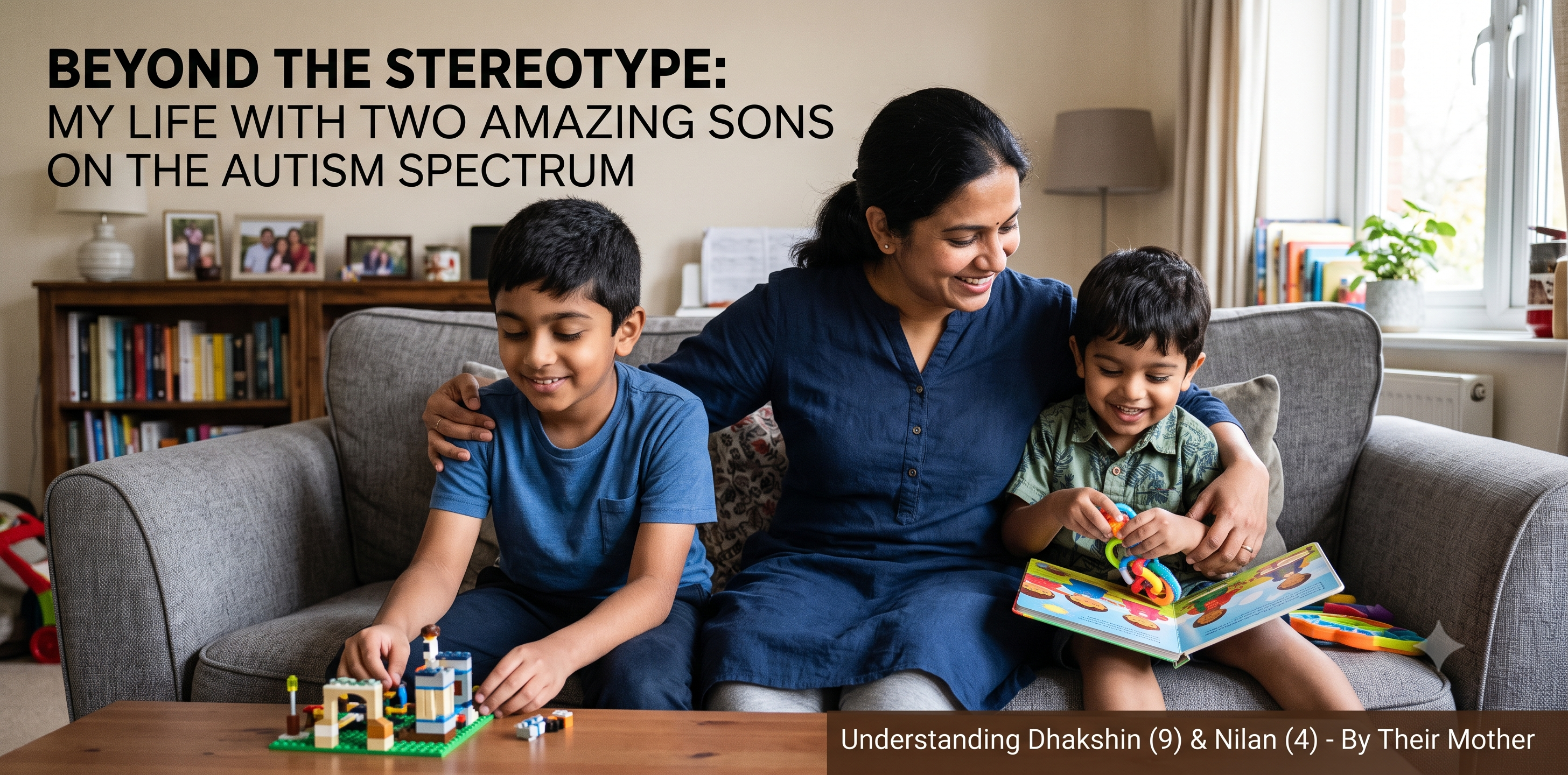
I am a mother to two wonderful boys on the autism spectrum.
My older son, Dhakshin, is 9 years old and has high-functioning autism. His challenges are not always obvious. He struggles with fine motor skills, understanding social cues, and navigating situations that many people take for granted.
My younger son, Nilan, is 4 years old and has moderate autism. His needs are different, his way of communicating is different, and his journey looks very different from his brother's.
Living with two children on different parts of the spectrum has taught me that autism cannot be understood by looking at one child alone.
Here are ten things I wish more people knew before meeting my children—or any autistic child.
1. There Is No "Typical" Autistic Child
Every autistic child is unique.
Some are talkative, while others communicate with very few words. Some enjoy being around people, while others prefer their own space. Some love routines, while others seek constant movement and exploration.
Two children can have the same diagnosis and still be completely different—just like my two sons.
The first step toward understanding autism is letting go of expectations.
2. Communication Can Look Different
Not every child communicates through spoken words.
Some use gestures, facial expressions, pictures, devices, or body language. Others may repeat words or phrases while they process information.
Communication is more than speech.
Instead of focusing on how a child communicates, try to understand what they are trying to tell you.
3. Eye Contact Is Not the Measure of Connection
Many people expect children to look directly into their eyes while listening or speaking.
For some autistic children, eye contact can be uncomfortable or overwhelming.
A child can be listening carefully without looking directly at you.
Connection is built through understanding—not eye contact.
4. Please Give Them Time
Many autistic children need a little extra time to process information.
If you ask a question, pause before repeating it.
Those few extra seconds can make all the difference.
Patience often creates better communication than speaking louder or faster.
5. A Meltdown Is Not Misbehavior
One of the biggest misconceptions is confusing a meltdown with a tantrum.
A meltdown happens when a child becomes overwhelmed by their surroundings, emotions, or sensory experiences.
It is not about seeking attention or refusing to cooperate.
During those moments, children need calm support—not criticism.
6. Celebrate the Small Victories
A child saying a new word.
Holding a pencil correctly.
Trying a different food.
Joining a group activity.
Making eye contact for a few seconds.
These moments may seem ordinary to others.
For many families, they represent weeks or even months of practice, patience, and encouragement.
Small victories deserve big celebrations.
7. Please Don't Compare
One of the most difficult questions parents hear is:
"He's the same age as my nephew. Why isn't he doing that yet?"
Every child develops differently.
Comparison doesn't help children grow—it only adds unnecessary pressure to families.
Instead of comparing, celebrate each child's individual progress.
8. Include Them
Sometimes people hesitate to invite autistic children to birthday parties, games, or family activities because they worry the child won't participate "normally."
Inclusion doesn't require perfection.
Sometimes simply being welcomed is enough.
Every child deserves the chance to belong.
9. Parents Are Learning Too
Parents don't have all the answers.
We learn through experience, conversations with professionals, trial and error, and, most importantly, from our children themselves.
Some days we feel confident.
Some days we feel overwhelmed.
A little kindness and understanding from others can make a world of difference.
10. See the Child Before the Diagnosis
Autism is part of who my children are, but it does not define everything about them.
Dhakshin is curious, thoughtful, and loves learning.
Nilan has his own beautiful personality, unique interests, and joyful moments that brighten our days.
Before seeing a diagnosis, see a child.
A child who wants to be accepted.
A child who wants to learn.
A child who wants to be included.
A child who deserves kindness.
A Final Thought
Living with autism has taught me that progress is not measured by how closely a child matches someone else's expectations.
It is measured by courage, persistence, growth, and the love and support that surrounds them.
If each of us chooses patience over judgment, inclusion over exclusion, and understanding over assumptions, we can create a world where every autistic child has the opportunity to thrive.
Because sometimes, the greatest difference we can make is not by changing the child—but by changing the way we see them.
.png)