
Imagine standing at the foot of a dense, unfamiliar forest. You’ve been handed a map, but as you unroll it, you realize the key is written in an intricate cipher you’ve never seen. Everyone around you steps onto the trail with ease—laughing, conversing, and moving effortlessly ahead.
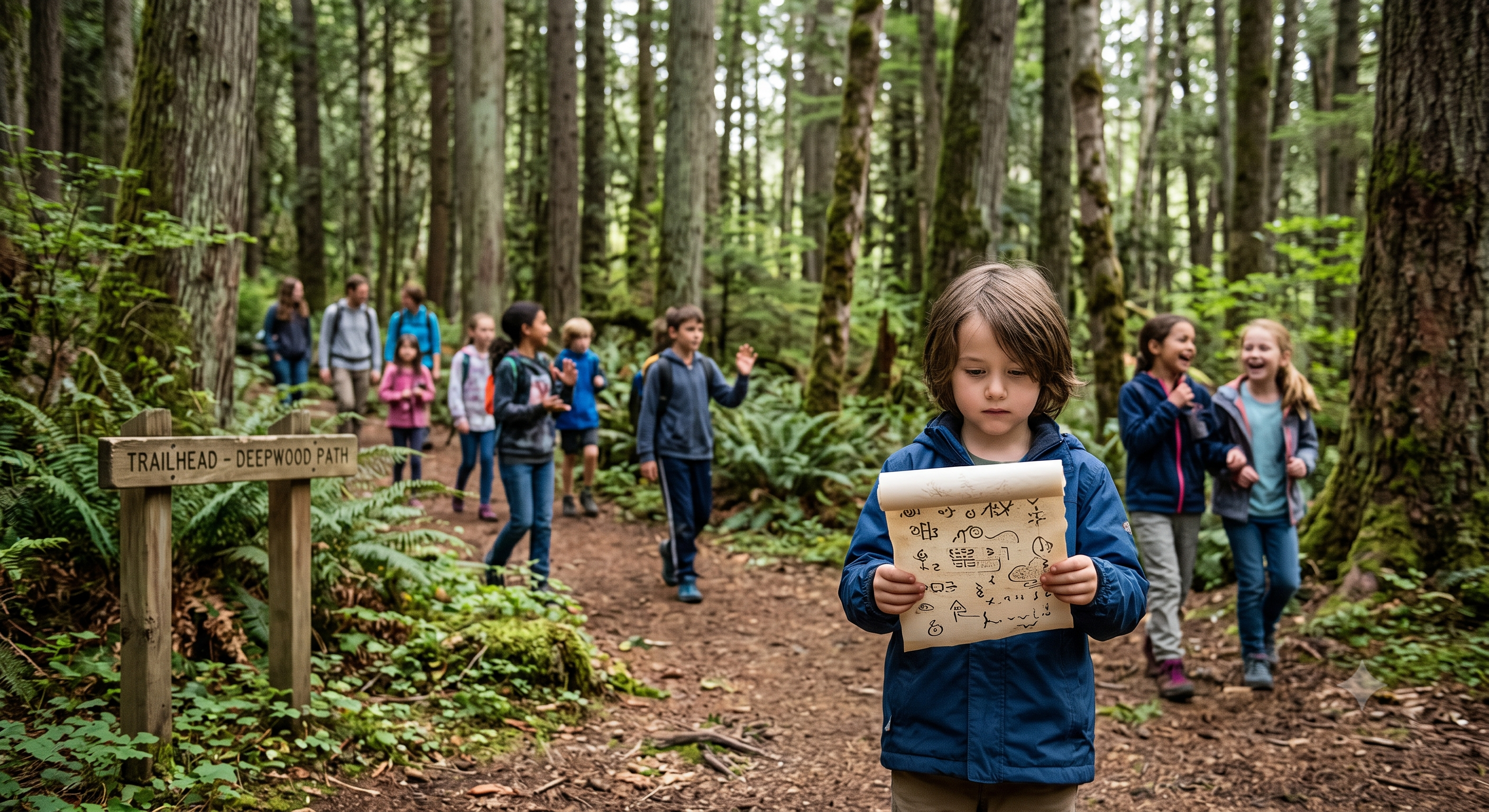
You try to decode the first symbol. Your heart rate quickens. Your brain works at 200% capacity just to identify the very start of the path. Meanwhile, an instructor behind you keeps encouraging you with good intentions: "Just look closer. Try harder."
Eventually, mental exhaustion settles deep into your bones. Your brain hits an absolute wall. Do you keep pushing until your system breaks down, or do you stop?
For a child with a Learning Disability (LD)—whether it is Dyslexia (reading), Dyscalculia (math processing), Dysgraphia (writing and spatial planning), or Non-Verbal Learning Disability (NVLD)—the traditional classroom or home study session is that exact high-stakes, exhausting mountain hike.
The Invisible Engine Room: What LD Processing Actually Demands
A Learning Disability is never a measure of intelligence, curiosity, or motivation. It is a fundamental structural difference in how the brain receives, organizes, filters, and retrieves information.
To the outside world, a child sitting at a desk looks entirely calm. On the inside, however, their nervous system is running a relentless marathon.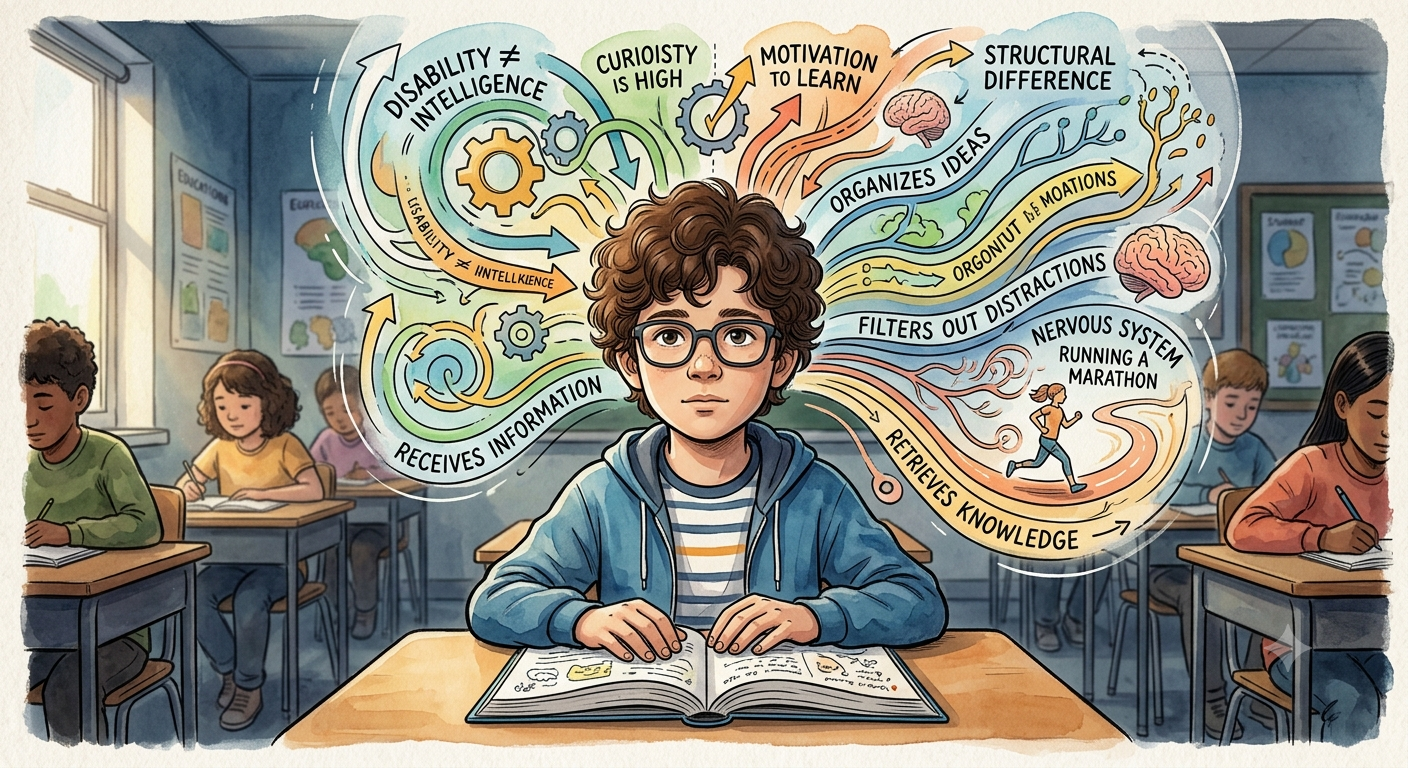
When processing isn't automated, every single micro-step demands deliberate effort:
- Continuous Decoding & Transcoding: For a child with Dyslexia or Dysgraphia, seeing a letter and translating it into a sound—or turning an idea into physical handwriting—is not automatic. It requires manual, step-by-step mental assembly for hours at a time.
- Working Memory Overload: Imagine holding six unstable items in your hands while trying to open a heavy door. Children with math and language learning differences must hold formulas, syntax rules, and sequence steps in their short-term memory simultaneously, leading to rapid cognitive fatigue.
- Chronic System Arousal: The background fear of being called on, failing in front of peers, or being labeled "lazy" keeps the autonomic nervous system on high alert. The body releases cortisol and adrenaline, making deep focus nearly impossible.
When a child with an LD shuts down, pushes a paper away, or refuses to open a textbook, they aren't being "defiant." They are demonstrating that their neurological capacity for that task has been utterly spent.
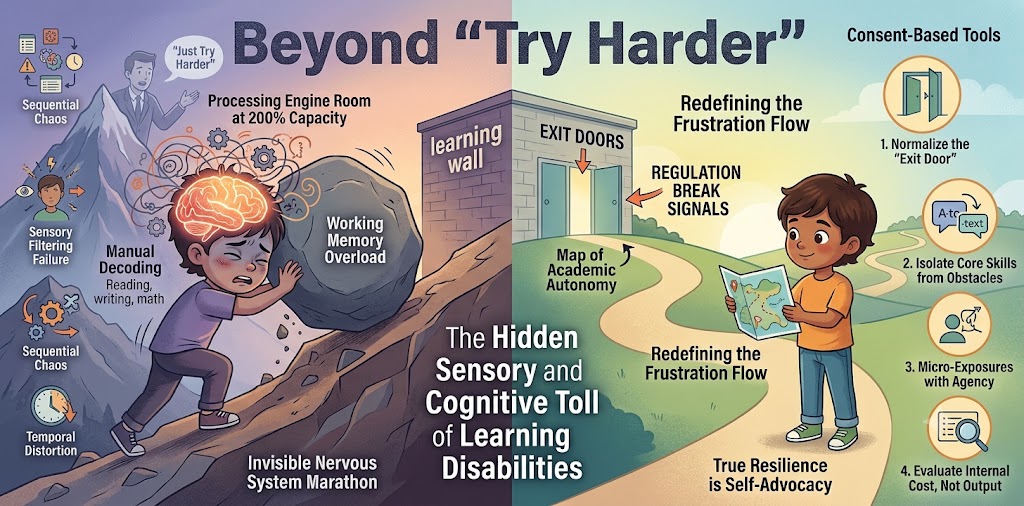
Redefining the "Frustration Flow" in Education
In traditional learning environments, when a child encounters an overwhelming academic wall, the standard behavioral instruction is almost always: "Keep trying. Take a breath and attempt one more problem."
We condition children to believe that pushing through dysregulation and fatigue is the only valid sign of success. But true neuro-affirming support introduces a critical, equal path on the map: Knowing when to stop.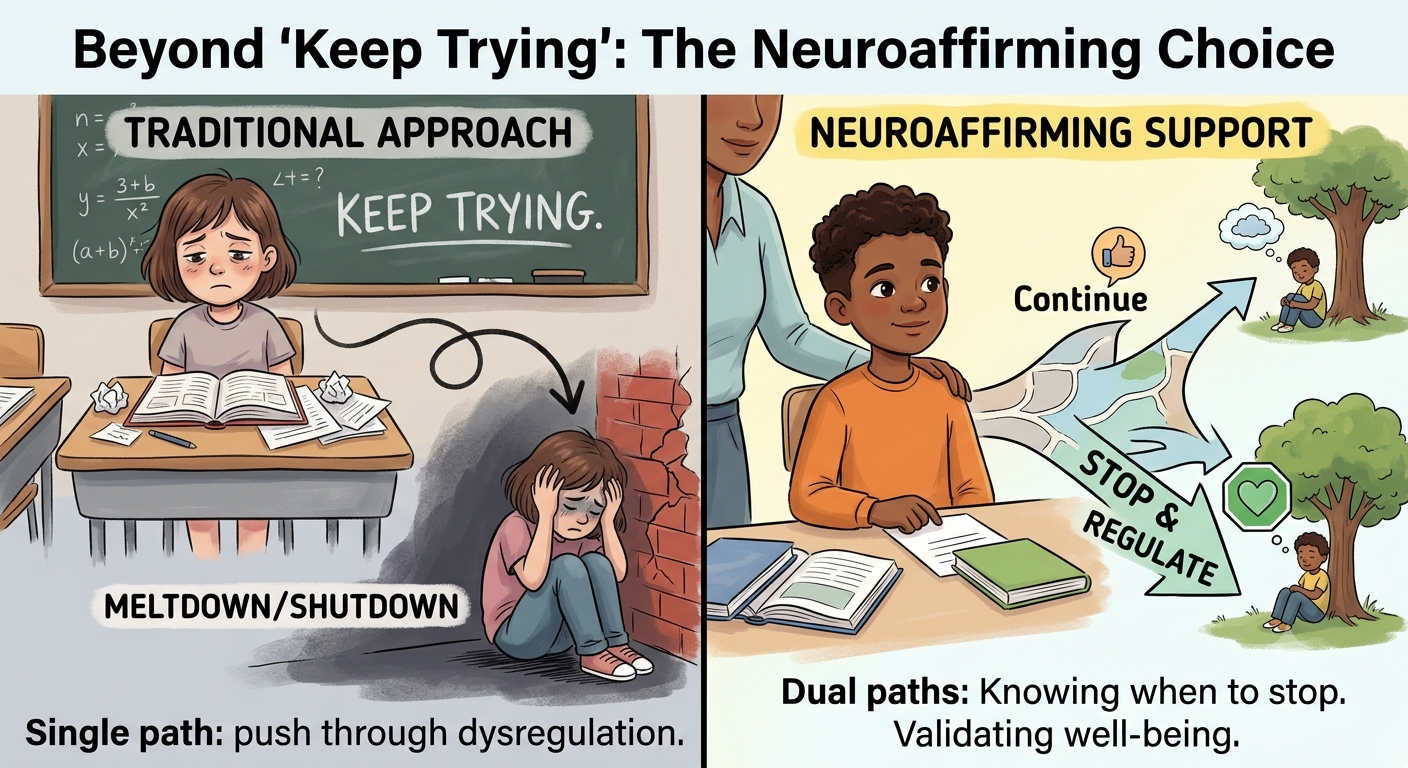
When we force a child to "keep trying" far past their point of neurological exhaustion, we erase the Stop & Regulate branch from their chart. We lock them onto a single track that almost always ends in a meltdown, shutdown, or complete loss of self-worth.
4 Concrete Ways to Implement Consent-Based Learning
Transitioning from forced compliance to consent-based learning transforms the educational experience from a trap into an invitation.
1. Protect and Normalize the "Exit Door"
Before starting a challenging task, explicitly establish a clear, non-judgmental break signal (a visual card, a word, or a hand gesture). When a child knows they hold the power to pause, the threat level drops, making them far more willing to initiate the work.
2. Isolate the Core Skill from Mechanical Obstacles
Do not let physical or processing bottlenecks hide a child’s true knowledge:
If Dysgraphia prevents them from writing down their complex science ideas, introduce speech-to-text or dictation.
If Dyscalculia causes math facts to slip, provide a reference chart so they can focus on high-level problem-solving concepts without getting stuck on basic computation.
3. Practice Micro-Exposures with Total Agency
Building academic stamina works best in tiny, controlled bursts where the child remains in complete control:
“Let’s read just two sentences. If you want to stop right there, we stop—no questions asked.”
Respecting their boundary builds deep internal safety and trust, paving the way for longer engagement in the future.
4. Evaluate the Internal Cost, Not Just the Output
Instead of asking, "Did they complete the entire assignment?" ask:
"What did it cost their nervous system to complete it?"
If finishing a single worksheet drains a child so thoroughly that they spend the rest of the evening dysregulated, tearful, or shut down, the accommodations must be adjusted immediately.
True Resilience is Self-Advocacy
Our ultimate goal for children with Learning Disabilities is not to teach them how to endure chronic discomfort silently. It is to prepare them with thorough self-understanding and safety that they can confidently advocate for their own needs throughout life.
When we honor their communication and protect their boundaries, we show them that their human value is not tied to speed, output, or standardized metrics. We give them a safe place to land—and that is the foundation upon which true learning occurs.

.png)